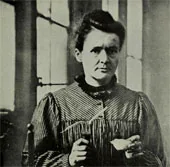
The interesting clue was not a bright glow. It was a measurement that seemed too large. Some uranium-bearing material gave off more activity than uranium alone could explain.
Marie Curie's discoveries grew from taking that mismatch seriously, then doing the slow, exhausting work needed to turn a signal into evidence for new elements.
A measurement opened a new line of inquiry
Curie used measurements to investigate radiation after Becquerel's uranium discovery. Her comparisons helped show that the activity concerned atoms, rather than only their chemical arrangement. The work followed unexplained readings through tests, turning an unexpected signal into a research question about the nature of matter.
The instruments mattered as much as the idea. A reproducible reading allowed an unexpected result to become a research question instead of a curious impression.
Curie did not begin with a complete map of the invisible process. She built an argument by comparing substances, checking measurements, and following results that did not fit the simplest expectation.
Pitchblende suggested something still hidden
Pitchblende showed more activity than uranium alone could explain. Marie and Pierre Curie separated its components and followed the radiation through the resulting fractions. This linked chemistry with measurement, narrowing the search for hidden substances while leaving the difficult task of obtaining and identifying purer material.
Imagine sorting a large crowd while listening for a faint, persistent sound. Each separation narrows the search, but the sound alone does not yet provide a pure sample.
That comparison captures the patience involved. Identifying a promising fraction and isolating enough material for stronger chemical proof were related tasks, but they were not the same achievement.
Related Stories


Two new elements emerged from sustained work
The Curies announced polonium and radium in 1898. Polonium's name honored Marie's Polish homeland, while radium became closely associated with the public image of radioactivity. The announcements marked major discoveries, but the work of isolating, measuring, and characterizing the substances continued beyond the moment that a short timeline usually records.
Processing large quantities of material required physical effort as well as analysis. Repeated chemical steps transformed a small signal into a body of evidence.
Recognition came in different scientific fields
Curie received the physics Nobel Prize in 1903 and the chemistry prize in 1911. The first was shared with Becquerel and Pierre Curie. The awards recognized linked but distinct achievements, placing her work within a wider effort to understand radiation, elements, and the structure of matter.
Becquerel and Pierre Curie shared the 1903 physics award with her. The 1911 chemistry award recognized Marie Curie's own continuing achievements.
Remembering the collaborators does not reduce her role. It gives a more accurate picture of how measurements, ideas, chemical methods, and laboratory work came together at a turning point in science.
The legacy includes tools and a hard lesson
Curie's work contributed to the foundations of nuclear science and to applications involving radiation, including medical uses. During the First World War, she helped organize mobile X-ray services. Her story also belongs to the history of learning about radiation hazards.
The famous image of a glowing substance can distract from that legacy. Visible light is not a reliable measure of radiation or its danger.
Curie was born Maria Skłodowska in Warsaw and later worked in France. Her story crossed national borders as well as scientific fields.
Her two Nobel Prizes mark achievements built on years of measurement and chemical work.
Frequently Asked Questions
Questions about Curie merge several discoveries into one or confuse glow with radioactivity itself. These answers separate the early observation, the new elements, and the later recognition. Her achievements become clearer when the dates and collaborators remain in view rather than disappearing behind a simplified image of a solitary genius.
Did Marie Curie discover radioactivity first?
Henri Becquerel discovered uranium radiation before her major studies. Curie developed the investigation greatly and helped establish the broader concept and evidence for radioactive elements.
Which elements did the Curies discover?
Marie and Pierre Curie announced polonium and radium in 1898. Further work was needed to isolate and characterize the substances more fully.
Was her work limited to a laboratory?
No. Her wartime work included helping bring X-ray imaging to medical care. Her wider legacy connects fundamental measurement with practical tools and scientific training.