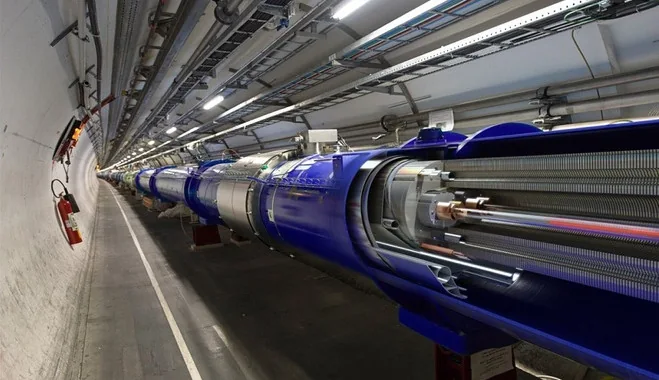
A ring about twenty-seven kilometers around exists to investigate things too small to see. Inside the Large Hadron Collider, protons circle in opposite directions before selected encounters. How the LHC works is a story of careful control: make beams, guide them, collide them, and reconstruct what happened from the traces left behind.
A chain of machines prepares the protons
Proton beams reach the LHC through a chain of earlier accelerators. They travel in bunches within a very low-pressure environment. Two beams move in opposite directions in separate pipes, meeting at selected collision points rather than striking each other everywhere around the large ring at once.
The vacuum reduces unwanted interactions with gas. It is one part of a larger system designed to preserve and control the beams.
Electric fields add energy and magnets guide the route
Electric fields add energy to particles, while superconducting magnets guide and focus the beams. These are separate tasks. The magnet system needs extreme cooling, so refrigeration and control form a major part of the machine alongside its vacuum equipment and particle-physics experiments.
A magnet does not simply make every proton faster around a corner. Acceleration and guidance are related parts of the machine with different physical functions.
The scale of the ring reflects the challenge of steering very energetic particles. Its cold equipment, vacuum, power systems, and controls must work together for useful operation.
Related Stories



Collisions turn concentrated energy into new possibilities
Particle collisions let physicists study high-energy interactions and particles that quickly decay. Detectors record traces and energy deposits left by the products. Researchers then test which processes fit those clues; they do not photograph a proton opening like a box full of smaller objects.
Most events are not rare discoveries. The machine produces a vast amount of data, and systems select information that may be useful for analysis.
The scientific challenge includes distinguishing a meaningful pattern from ordinary background. One unusual event rarely establishes a new particle or a new law of nature by itself.
Detectors reconstruct the invisible through many layers
Detector layers record different clues from a collision. Some track charged particles, while others measure energy or help identify particle types. Software combines the signals into a reconstructed event, which scientists compare with models after checking how the instruments respond and how accurately they measure.
The familiar colorful event display is a visualization of processed measurements. It is not a direct camera image of tiny glowing tracks inside empty space.
A discovery needs a pattern that survives checks
A discovery requires a pattern that survives checks against background events and measurement errors. The Higgs boson result announced in 2012 met that kind of test. Later work asks further questions; no collider run guarantees a new particle or an answer to every cosmic puzzle.
CERN's collider is therefore both a machine and a shared research effort. Engineering keeps the beams usable, while scientific work determines what the recorded patterns mean.
The experiments also study results that agree with existing theory. A more precise value can rule out a tempting new idea or narrow the room in which it could work. Such results may make fewer headlines than a new particle, but they are part of discovery.
Better measurements change what scientists can claim. The value of a large instrument is therefore not counted only by how often it announces a surprise.
Frequently Asked Questions
These questions separate the accelerator from its detectors and the analysis of their data. The ring controls beams and creates collisions. The experiments record clues, while researchers decide what those clues support through checks, comparisons, and statistical tests rather than through one striking event display.
Do the beams move exactly at the speed of light?
No. Protons have mass and travel very close to, but below, light speed. Adding energy does not make them reach or exceed that limit.
Is an event display a direct photograph?
No. It visualizes reconstructed detector measurements. Its lines and colors help show information that sensors and analysis have inferred from the recorded signals.
Did finding the Higgs boson end the project?
No. The LHC supports many investigations and more precise tests. A major discovery opens further questions rather than completing every goal of high-energy physics.