

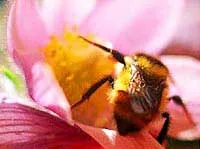
Inside a dark hive, a worker bee runs a short line while shaking her body. She turns, loops back, and runs it again. The bee waggle dance turns movement into a clue about food beyond the hive, where a patch of flowers may be waiting far out of sight.
A short run carries more than excitement
The waggle run is the central straight part of a honeybee's dance. Its angle and duration can convey data about the direction and distance of a useful resource. Other bees follow nearby and gain clues, although finding the exact flowers also involves scent, local conditions, and their own search.
The dance is not a tiny written address. It gives a direction and an estimate of travel, which followers combine with other signals. This makes the hive less like a room full of orders and more like a group sharing leads worth checking outside.
The Sun provides a moving reference
On a vertical comb, the dance angle relates the flight direction to the Sun's position. A run tilted one way from upward can signal a matching angle in the landscape. Honeybee navigation therefore translates a sky-based reference into a pattern that nestmates can follow inside a dark space.
The sun angle changes over the day. Bees have ways to use time and sky cues. So the system is more subtle than a fixed arrow.
Clouds and local conditions can affect what a forager sees. But the basic reference is not a street on a map.
Related Stories


Duration helps point beyond the nearest flowers
The length of the waggle phase gives a cue related to distance. It is not a perfect ruler marked in human units. The bee's experience of the outward flight helps shape the signal, so terrain and visual motion can matter when researchers compare dance timing with the route actually traveled.
A trip over one kind of landscape may offer more passing visual detail than another. That is one reason to test real flights rather than assume every second of dance always means exactly the same number of yards in every setting.
Smell helps turn a direction into a destination
Flower scent can help followers recognize the resource once they reach the right area. A forager may also share a sample of food. Together, the dance and these other cues help bees search effectively, rather than forcing them to locate one flower using a direction signal alone.
Picture several flowering patches along a similar bearing. An odor gives the arriving bee another way to sort them. The landscape is not empty space, and the data inside the hive works best when it is joined to what the bee finds during the trip.
Researchers check the message against real flights
Foraging bees can be trained to visit known feeding sites, allowing researchers to compare dances with the routes involved. Tracking or observing recruited bees helps test whether followers use the data. The key evidence is the link between signal and behavior, rather than the charm of the dance itself.
The work also reveals limits. A useful signal can still be noisy, and bees may choose among several leads. There is no need for perfect precision for the system to help a colony gather food across a wide and changing landscape.
Frequently Asked Questions
The dance shares a lead, not a perfect route with every turn fixed. These questions connect its angle and timing with scent and flight. A follower still has work to do outside, using the message with the sky and the flowers it meets rather than obeying a written address.
Do all bees use the same waggle dance?
No, the classic account is about honeybees, and details vary among species. Other bees can share food cues in other ways, so the broad name does not imply one common dance for all.
Is the dance just a sign that food exists?
It gives clues to direction and distance as well as food being present. Scent and other signals help the follower turn those clues into a search for a useful patch of flowers.
Can bees dance when the Sun is hidden?
They can use more than a direct sight of the Sun. Time and other sky cues also help, though weather and local conditions may still affect the route and success of a flight.





