

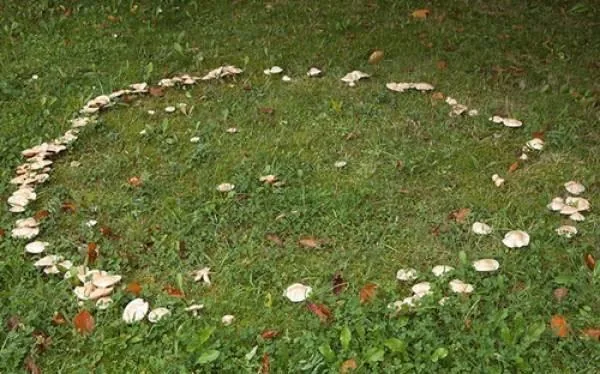
After rain, a ring of mushrooms appears where yesterday there was only grass. Its shape is so neat that it seems drawn for a story. Fairy rings explained leads below that circle, to a spreading web that can leave the center behind while its living edge moves quietly outward.
The mushrooms are a small part of the organism
Fungal threads grow through soil and dead organic matter, taking up food as they spread. Mushrooms are the brief fruiting bodies we see above ground. Their ring can mark an active edge of a much larger web, not a group of separate plants placed neatly around a circle by hand.
Most of the life stays hidden. The caps may arrive after rain and fade soon, while the web remains below the grass. That sudden show above a slow unseen process is part of what makes the ring feel strange to someone who finds it on a normal walk.
Growth can spread from a starting point
Outward growth from one patch can make a wider circle as the edge reaches fresh food. The middle may become less useful to the fungus. Roots, stones, water, and soil change the shape, so a real ring need not be perfectly round or bear mushrooms everywhere along its edge.
A gap is not a fatal flaw in the account. It may be a barrier or a patch where no caps formed that season. The useful clue is growth across the ground, not a rule that every visible mushroom must sit on one faultless line like beads on a string.
Related Stories

The grass may reveal a ring without any mushrooms
Grass rings can appear because fungi change soil conditions and nutrient availability. Some regions may look greener, while others become stressed or dry, depending on the fungi and setting. A ring in a lawn need not have visible caps on the day it is noticed or photographed from a distance.
This is one reason a single image can be hard to interpret. Different processes can create circular marks, and several kinds of fungal ring exist. Looking at the soil, seasonal change, and actual fungi gives a stronger answer than naming the feature from shape alone.
Stories gave the circle a place in human life
Folklore in parts of Europe linked mushroom rings with fairies, dancing, enchantment, or danger. Versions differ across regions and time; these traditions help explain the name. But they should be described as stories people told, rather than evidence that one supernatural event caused every circular patch of mushrooms.
The tales capture a real feeling of surprise. Understanding the biology does not erase that atmosphere; it adds a second story about growth, weather, and the soil beneath an ordinary walk.
A natural pattern is not an invitation to taste
Mushroom caps cannot be judged safe to eat from their circular arrangement. Different species can form rings, and mistaken identification can be dangerous. The shape provides a clue about growth, not edibility, so a photograph and a fairy-ring label are not enough for a food decision.
Watching the pattern is a safer way to enjoy it. Note how the ring changes after rain and whether its edge shifts across seasons. That quiet record can reveal a living process without disturbing the ground or turning uncertain identification into an experiment at the dinner table.
Frequently Asked Questions
A ring gives a clue about growth, not a promise about the mushrooms' name or safety. These questions link the brief display above ground to the web below it. They show why a neat circle and an old fairy story cannot tell us whether a cap is safe to eat.
Are fairy rings made by many separate mushrooms?
The caps can arise from one linked fungal web in the soil. Each is a fruiting body, not the whole life form, and most of the growing network stays hidden under the grass.
Why is part of a ring missing?
Growth and fruiting conditions can change around the edge. Stones, roots, dampness, and nutrients may leave gaps, so a broken circle can still arise from the same broad process of spreading growth.
Are mushrooms in fairy rings safe to eat?
The ring does not establish that. Different fungi can form circles, and some errors in naming them are dangerous, so shape and a quick photo are not enough for a safe food choice.





