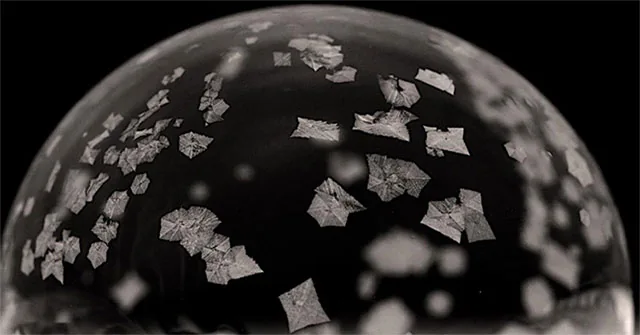
Tiny ice crystals race across a soap bubble as if someone has shaken a miniature snow globe. A freezing soap bubble video makes a familiar change of state look strangely restless. The film is not just becoming cold and hard.
Freezing releases heat, and that heat can help set the remaining liquid in motion.
A bubble places water in an unusually thin shape
A soap bubble holds water in a very thin curved film. That geometry changes how heat moves and ice grows compared with a puddle. The remaining liquid can also flow, so a bright moving crystal is not always a fixed frost pattern spreading on a solid shell.
This matters when watching a close-up. A moving bright shape may be an ice crystal traveling within the film, rather than a fixed pattern spreading across a solid surface.
Freezing gives off heat at the growing edge
Water releases latent heat as it freezes. Cold surroundings remove heat, while the growing ice warms nearby material locally. Both processes can occur together, creating temperature differences that influence the rest of a bubble; the pattern depends on how the experiment cools the film and its surroundings.
A cold environment removes heat, while a growing crystal releases it. Both can happen at the same time in different parts of the system.
The resulting temperature pattern depends on the setup. A bubble in uniformly cold air can behave differently from one cooled mainly through contact with a cold surface while warmer air surrounds the rest.
Related Stories


Uneven surface tension can drive circulation
Marangoni flow is motion driven by differences in surface tension. Temperature changes can create those differences in a soap film. Under suitable cooling conditions, the flow moves ice crystals around a freezing bubble, producing a swirling display instead of only one simple front of growing ice.
The effect links heat transfer with fluid motion. A small change at the growing ice can influence a much larger area of the remaining film.
Slow motion reveals a sequence the eye may miss
Slow motion can reveal when crystals form, move, and spread. A useful video states the setup and playback speed, so viewers do not confuse altered timing with the natural pace. Those details connect the striking display to a testable process rather than an unexplained visual trick.
These observations make the footage useful beyond its beauty. They help connect a visible pattern with a physical mechanism that can be tested under controlled conditions rather than only admired online.
A clear explanation should accompany the original footage
The strongest presentation pairs verified footage with a short account of the cooling conditions and the mechanism being illustrated. A still image is not a video, and an artist's animation is not a recording of an experiment. Labels should make those differences clear.
The tiny bubble then becomes more than a seasonal trick. It shows how phase change, temperature gradients, surface forces, and fluid motion can interact inside something so fragile that a fingertip could destroy it.
A video can also hide failed trials. A research report should explain how often a pattern appeared and what changed when the setup changed. That makes the result easier to test than a single perfect clip.
The most useful visual record shows enough of the process to connect the first ice, the moving crystals, and the final state without cutting away the steps between them.
The thin film connects the crystal's local heat release with motion across the wider bubble.
Frequently Asked Questions
These questions separate the cold setting from the heat released during freezing. They also explain why crystals can move and why experiments differ. A reliable account names the cooling conditions and distinguishes recorded footage from animation, altered playback speed, and a still image used only as a preview.
How can freezing release heat in a cold place?
The liquid-to-solid transition releases latent heat. The surroundings can still be cold enough to remove that energy and allow more water to freeze.
Why do the crystals seem to move around?
In suitable conditions, surface-tension-driven flow can carry ice crystals through the liquid film. Their motion depends on the temperature pattern and the experimental setup.
Will every frozen bubble make a snow-globe pattern?
No. Different cooling conditions and soap solutions can produce different behavior. A dramatic example should not be presented as the inevitable result of every freezing bubble.