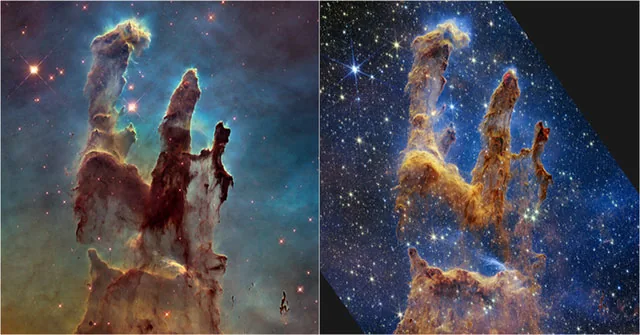
The same cosmic pillars can look solid in one image and almost transparent in another. Neither picture has to be fake. Pillars of Creation colors tell us how telescopes translate different kinds of light into something human eyes can study, while the gas and dust remain far more complex than any single beautiful frame can show.
The scene is a small part of a larger nebula
The Pillars of Creation are structures of gas and dust in the Eagle Nebula, a star-forming region thousands of light-years away. Their familiar shapes reflect dense material exposed to radiation and winds from nearby stars. The image shows a changing physical environment.
Dust clouds can block some kinds of light while allowing others through more readily. That makes the choice of wavelength central to what a telescope reveals.
The scene also has depth that a flat picture can conceal. Bright edges and overlapping structures do not by themselves tell us the full three-dimensional arrangement of the material.
Different wavelengths reveal different parts of the scene
Infrared light can reveal features obscured in some visible-light views, including many stars within or behind dusty regions. Other infrared wavelengths can emphasize the dust itself. A comparison between telescopes therefore needs to state which instruments and filters produced each image.
This explains why two valid images can look dramatically different. They are not competing portraits in ordinary daylight, but different measurements of the same region, assembled to answer different observational questions.
Related Stories


Color is a translation that needs a key
A color map turns telescope data into a view our eyes can read. Some of the recorded light lies beyond human vision. The chosen colors can show real patterns in brightness and shape, but they need a caption that explains the mapping.
Calling the image “false color” without explanation can imply deception where there is simply a documented translation. The useful question is what each color represents.
Young stars and eroding clouds share the frame
Star formation occurs when dense regions of gas and dust collapse under suitable conditions, while energetic nearby stars can also heat and erode surrounding material. The pillars sit within this active setting. The image therefore contains both creation and destruction in a broad physical sense.
Small bright points may be stars, while some colored structures trace gas or dust. Not every dot marks a newly born star inside the pillar itself.
Comparing images works best with context
Compare the field of view, filters, detail, and processing before claiming that the nebula has changed. A new instrument may reveal an old feature in a new way. Dates alone cannot tell us which visual differences mark real changes in space.
The reward is a richer kind of wonder. The colors stop being decoration and become a key to how astronomy turns distant light into evidence about matter, stars, and the environments where they form.
The displayed scene is also delayed by the time light took to reach us. We see the region as it was when that light left, not as it is at the instant we open the image. That is true of every deep-space picture.
The delay does not make the data less real; it tells us which past state the telescope records. A caption's distance estimate helps place the view in time as well as space.
Image processing is part of the measurement story and should be explained beside the finished picture.
Frequently Asked Questions
The pillars are real gas and dust, but the displayed palette is a translation. These questions explain the difference between the scene and its image. They also show why instrument details matter when readers compare pictures or ask what human eyes would see.
Are the pillars solid rock towers?
No. They are structures of interstellar gas and dust. Their sharp-looking outlines do not mean they have the material strength or density of mountains on Earth.
Are assigned colors the same as a fake image?
No. A documented color mapping can communicate real measurements. The caption should explain what the colors represent rather than imply an ordinary naked-eye view.
Does every difference between Hubble and Webb show change?
No. Different wavelengths, instruments, and processing reveal different features. A claim of physical change needs comparisons designed to separate those effects from the object's actual evolution.