A scrap of charcoal can carry a clock that no one built. The clock began when a living organism stopped taking in carbon, and it keeps running long after the fire, burial, or abandoned meal. Learning how carbon dating works reveals both its remarkable reach and the reasons archaeologists never treat one number as the whole story.
Living things take part in a carbon exchange
Plants take in carbon from their surroundings, and animals gain it through food. A small share is carbon-14, a radioactive form produced through processes linked with the atmosphere. After an organism dies, exchange largely stops, while the carbon-14 already present continues to decay at a predictable statistical rate over time.
The method therefore concerns material once connected with life. A stone wall does not become directly datable by carbon merely because an archaeologist finds it beside an old wooden beam.
A half-life describes a population of atoms
Carbon-14 has a half-life of about 5,730 years. That means half of a large starting amount is expected to decay during that interval. The process continues, leaving progressively less to measure, which is why radiocarbon dating has a practical age range rather than an unlimited reach into Earth's past.
Organic remains tens of thousands of years old may still be suitable, depending on preservation and measurement. Dinosaur fossils from many millions of years ago require other dating approaches and geological evidence.
Related Stories

A radiocarbon age needs a calendar bridge
Calibration curves help convert a measured radiocarbon age into a calendar estimate. The atmosphere's carbon-14 level has varied, so equal laboratory ages do not always translate into a simple count backward from today. Independently dated records, including tree rings, provide part of the bridge between the measurement and calendar time.
The calibrated result often appears as one or more ranges with stated probabilities. That is not a failure to give an exact birthday; it reflects the evidence honestly.
A date without its uncertainty can sound more precise than the method allows. The sample, laboratory process, calibration, and archaeological context all shape what can reasonably be concluded.
The dated material may be older than its use
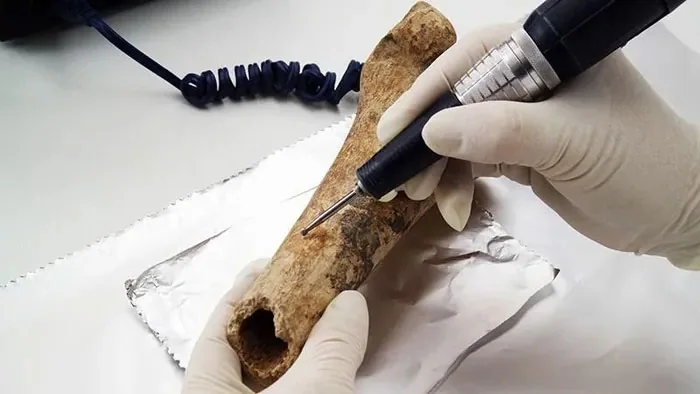
Carbon in an object can predate the event being studied. Old tree growth or reused timber may make wood older than a building. Contamination creates another problem, so sample choice and context matter before a laboratory result can be turned into a date for construction.
Sample contamination can create a different problem. New roots, conservation chemicals, or other carbon sources may alter a result unless they are recognized and addressed.
This is why sample selection matters before a machine takes a measurement. A very precise answer to the wrong archaeological question can still produce a misleading account of the past.
Context turns a laboratory result into history
Archaeologists compare radiocarbon evidence with layers, objects, building phases, and other dates. Several well-chosen samples can test an interpretation more strongly than one isolated result. The method is most powerful when researchers state what was dated, how it relates to the event, and which alternative explanations remain possible.
The clock in old carbon is real, but it does not read the excavation notebook for us. Human judgment connects the measurement to the lives and events we hope to understand.
A well-kept sample record lets another researcher follow the chain from trench to laboratory.
Frequently Asked Questions
The common questions involve suitable materials, age limits, and precision. The answers depend on sample quality and context, rather than a promise that every ancient object can receive one exact year. A report explains both the measured result and the chain of reasoning that connects it to a historical event.
Can carbon dating tell the age of any rock?
No. It generally dates suitable carbon-bearing material associated with once-living systems. Other methods are needed for most rocks and much older geological events.
Why do reports give a range of years?
Measurement uncertainty and calibration affect the calendar estimate. A range expresses those limits more honestly than a single year presented without qualification.
Can old wood make a building seem too old?
Yes. Wood may contain growth that predates its use, and a beam may have been reused. Archaeologists account for that possibility through context and sample choice.