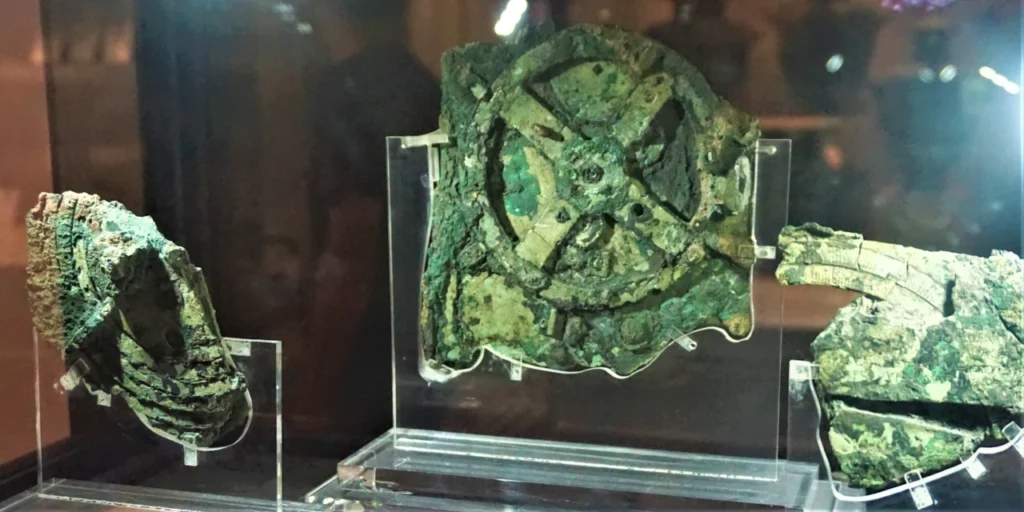
A lump of green bronze came out of a Greek shipwreck with a secret inside. Beneath the crust lay small gear teeth, cut by people who lived more than two thousand years ago. Here is the Antikythera mechanism explained, through the clues that turned a corroded object into evidence of remarkable skill.
A Shipwreck With an Unexpected Passenger
The shipwreck discovery near the Greek island of Antikythera brought an odd device to light in 1901. Its broken pieces held interlocking bronze gears. Unlike a statue or a coin, the object recorded motion, turning the slow rhythms of the sky into a machine that someone could operate.
Think of a box of crushed clock parts. You do not know what the clock once looked like. A tooth, a hole, or a shaft might be your best clue.
That is why the pieces matter more than a neat drawing of what someone hopes was once there.
What the Gears Could Tell You
The ancient Greek computer worked as a gear-based model, not an electronic brain. Gear ratios linked a hand-operated input to displays of astronomical cycles. Turning the mechanism could show calendar facts and lunar motion, while eclipse prediction depended on repeating patterns rather than a modern understanding of gravity.
One wheel turns the next. Its tooth count sets the rate. You can see a simple form of this on a bike, where gears change how fast the wheel turns.
The ancient maker used such links to track slow patterns in the sky with a turn of the hand.
Reading What Corrosion Hid
Scientists use imaging to examine details hidden inside the fragments. X-ray scans reveal gears, while surface images help recover tiny inscriptions. These clues let teams compare gear-based models with physical evidence, separating functions strongly supported by surviving material from arrangements that remain open to debate and further testing.
A word on the metal might name a dial that is now gone. A scan might show a wheel deep inside a crust. Each clue can test a model.
If a shaft does not fit a real hole, a clever plan still needs to change before we trust it.
Why the Machine Still Feels Surprising
The mechanism shows that ancient craftspeople could join careful skywatching with exact metalwork. It does not need a lost supercivilization to explain it. Its real wonder is the skilled human effort behind a portable model of the heavens, built long before electrical power or digital screens existed.
The word computer can make us think of screens and code. Here, think of a small box with dials instead. A hand turns it, and the dials show a pattern.
It takes skill to make such a thing, but not a secret power lost to the human race.
Frequently Asked Questions
The most common questions concern power, eclipses, and how much of the device has been recovered. The useful distinction is between a function supported by surviving evidence and a full reconstruction. A plausible working model helps test an idea.
But it does not replace the missing ancient pieces.
Was the Antikythera mechanism powered by electricity?
No, it used gear-based motion through connected gears. A person supplied the movement. And the gearing translated that input into changes on the displays.
Could it predict every eclipse visible from Greece?
Its eclipse cycle indicated possible eclipses, not a perfect modern local forecast. Visibility still depends on where an observer stands and the details of each event.
Has the whole device been rebuilt with certainty?
No, large parts are missing. Scientists test reconstructions against surviving gears and inscriptions. So some features are better shown than others.
Featured image: Joyofmuseums · Source · by-sa/4.0. Resized proportionally and converted to WebP when downloaded. No crop.
