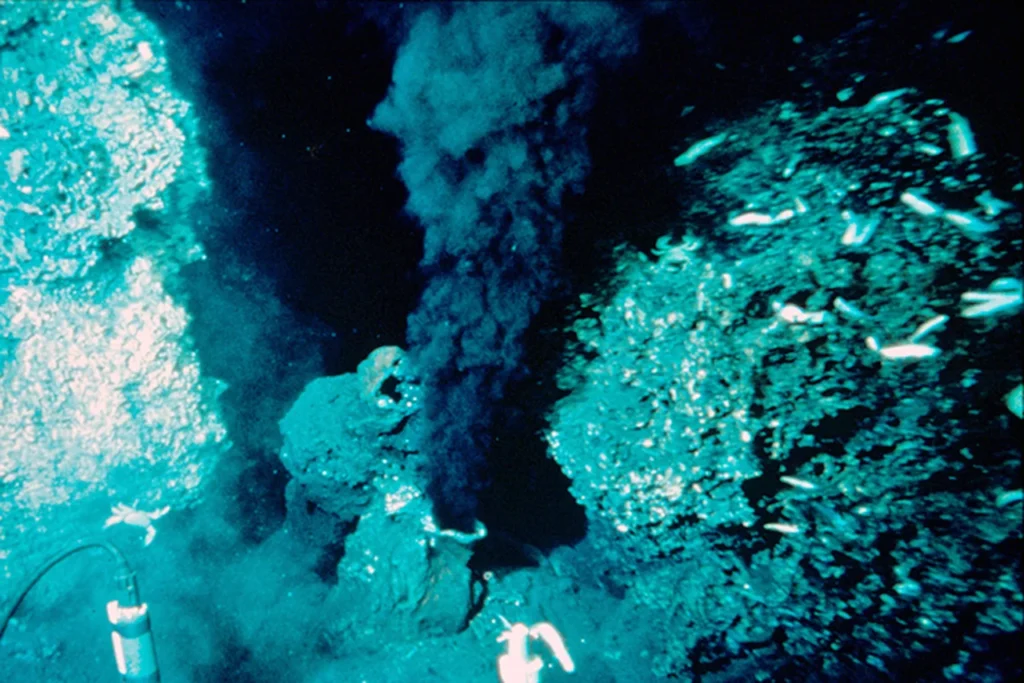
Far below the reach of sunlight, a chimney releases a dark plume into cold water. Nearby, living communities gather around a source that looks hostile. How hydrothermal vents support life begins with microbes doing a job usually associated with green plants, but using chemical energy instead of a sunlit leaf.
Seawater Takes a Hot Underground Route
Seawater seeps into cracks, warms near hot rock, and rises with dissolved matter. As it meets cold water at the seabed, some of that matter forms solid grains. These can build chimneys and make dark plumes.
The features called black smokers thus release fluid and particles, not smoke from fire.
The plume is not smoke from a fire. It is hot water with tiny bits of solid matter in it. Those bits form when the fluid meets cold seawater.
A black cloud can fool the eye, but knowing what it holds changes how we read the scene around a vent.
Microbes Build Food From Chemical Energy
Chemosynthesis uses energy from chemical reactions to build organic matter. At many vents, microbes use substances such as hydrogen sulfide as part of this process. They help feed the local web of life.
Sunlight is not the power source there, but the cells still need energy and raw materials.
A green leaf uses light to help make food. A vent microbe can use energy from a chemical reaction instead. Neither makes energy from nothing.
Each draws on a source in its setting, then builds matter that can feed other life. The source changes, while the need for a source stays.
Animals Depend on Invisible Partners
Some vent animals eat microbes. Others keep them as close partners that supply food. These links support deep-sea ecosystems at suitable sites.
The animals do not live on heat alone. To know how they survive, follow the food from the vent microbes through the rest of the local web.
A large worm or crab draws the eye in a photo. The smallest partners can be harder to see. Yet they may do much of the work that feeds the scene.
To understand a vent, follow what eats what and ask where the food first came from, not just which animals look most strange.
A Productive Place With Sharp Boundaries
Vent sites have sharp shifts in heat and chemistry. Animals often live where hot fluid mixes with cold water, not inside the hottest jet. The vents can change or shut down as the rock below shifts.
Rich life there depends on a narrow set of things going right at once.
Dark does not mean cut off from the whole world. Many vent microbes use oxygen linked to life in sunlit waters. So the phrase without sunlight needs care.
It describes a local way to gather energy, not a sealed world that shares no resources with the rest of Earth.
Frequently Asked Questions
Words such as smoke and heat can lead us down the wrong path. These answers explain what a plume holds, where food comes from, and how a dark site still links to the wider world. A vent can use chemical energy while sharing resources with life far from it.
Do hydrothermal vent animals eat heat?
No, heat is not their food. Microbes use chemical energy to build organic matter, and animals obtain nourishment through feeding or partnerships with those microbes.
Is a black smoker releasing smoke?
No, it releases hot fluid carrying mineral particles. The dark look forms as vent fluid mixes with colder seawater and dissolved substances precipitate.
Are all vent communities entirely independent of photosynthesis?
No, many rely on substances such as oxygen supplied through wider Earth systems. Their local primary production can use chemical energy without making every connection to photosynthesis disappear.
Featured image: W. R. Normark and Dudley Foster / USGS · Source · public-domain. Resized proportionally and converted to WebP when downloaded. No crop.
