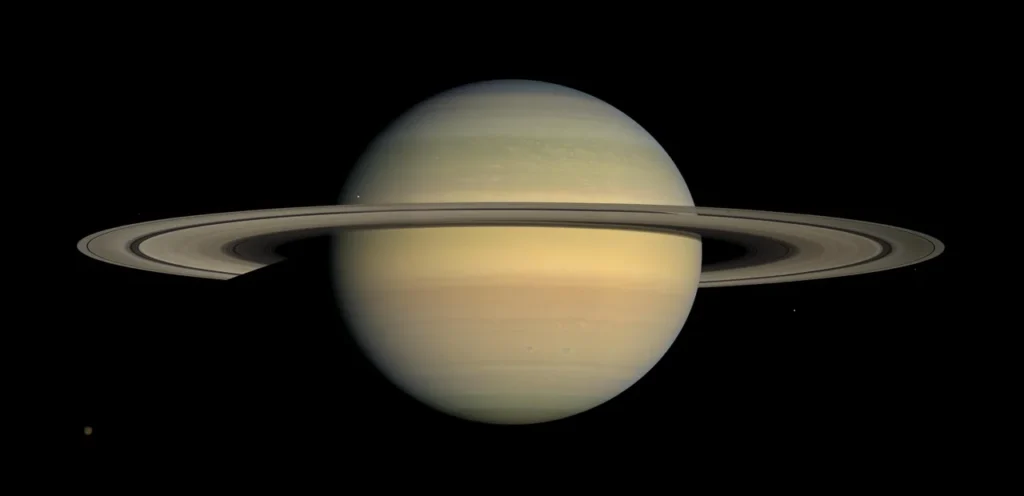
Saturn's rings look smooth enough to be cut from a single bright sheet. Move closer in your imagination, and that sheet breaks into countless distinct objects. What are Saturn’s rings made of?
The view from a distance hides a moving collection of icy particles, each following its own path around the planet.
A Bright Band Made of Separate Pieces
Saturn's main rings consist largely of water ice particles, with other material such as dust and rock. The particles span many sizes, rather than forming solid circular shelves. Sunlight reflected from this icy population creates the broad bright bands seen through telescopes.
Meanwhile, single pieces remain too small to resolve.
A beach can look smooth from a plane. On the ground, you see grains. Saturn’s rings hide their pieces in much the same way, though on a vastly greater scale.
A smooth look from far away does not mean there is a solid surface waiting for a foot to land on it.
Each Particle Has Its Own Orbit
Ring material travels around Saturn under gravity, and orbital speed changes with distance from the planet. Inner particles complete their paths faster than outer particles. A ring system therefore does not rotate like a rigid record, even though a still image makes its bands look fixed together as one object.
Think of many lanes whose speeds change with their distance from the center. The picture is rough, but it helps. A line drawn across the rings would not be one fixed spoke.
The pieces along it each follow their own paths, so the line would not stay straight over time.
Why the Gaps Are Part of the Story
Moons and gravitational resonances help shape ring structure, such as some ring gaps, sharp edges, and waves. The Cassini spacecraft recorded intricate features that were hard to see from Earth. Those records turned the rings into a laboratory for studying how small bodies interact within a larger gravitational system.
A gap need not be a perfectly empty ditch. The amount of matter can change from place to place. A faint ring may hold more than the eye first sees.
Fine lines and waves are clues to moving ice and gravity, not cracks cut into the face of a single broad disk.
A Moon Can Feed a Faint Ring
Enceladus plumes supply icy material to Saturn's diffuse E ring, showing a link between a moon and its surroundings. That example does not explain the origin of every ring. Questions about the main rings' age and history remain active research topics, with conclusions depending on readings, models, and their assumptions.
The rings look still in a photo. The evidence shows motion and exchange. A moon can send out fresh ice, and tiny bodies can tug on other paths.
Their beauty does not fade when the solid disk disappears. It grows as those bright bands turn into countless separate journeys through space.
Frequently Asked Questions
Questions about standing on a ring or watching it turn usually begin with the image of a solid disk. Replacing that picture with distinct orbiting particles answers much of the confusion. Moon interactions and differences among the rings add detail, showing why one explanation cannot cover the whole system.
Could you stand on Saturn’s rings?
No, the rings are not a solid platform. They consist of distinct orbiting particles with a wide range of sizes.
Do all ring particles move at the same speed?
No, orbital speed depends on distance from Saturn. Material closer to the planet generally travels around it faster than material farther out.
Did Enceladus create every ring around Saturn?
No, its plumes supply material to the diffuse E ring. The main rings have a distinct and still-studied origin story.
Featured image: NASA/JPL/Space Science Institute · Source · public-domain. Resized proportionally and converted to WebP when downloaded. No crop.