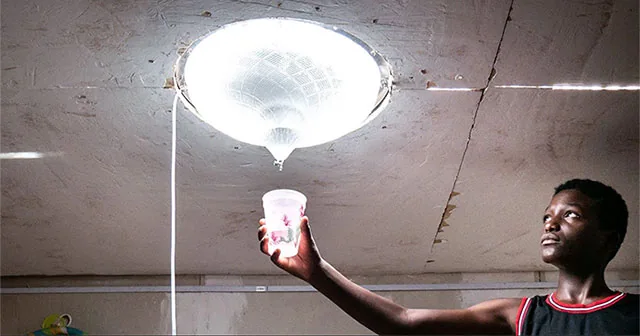
A clear drop forms on a cool surface above salty water. The salt stayed behind while the water took a short journey through the air. Solar water distillation turns that familiar change of state into a useful idea, but its promise depends on how much fresh water a real device can collect, not just whether one drop appears.
Sunlight supplies the heat for evaporation
A solar still warms water with sunlight, lets vapor rise, and collects condensed drops elsewhere. Most dissolved salts remain in the source liquid. The design must keep the collected water separate, because a drop that falls back into the brine adds nothing to the usable output.
The sequence is simple: warming, evaporation, condensation, and collection. The design challenge is making each step happen efficiently within the same device.
A transparent cover can admit sunlight while providing a condensing surface. Its slope, temperature, and drainage matter because a drop that falls back into the brine is not useful collected output.
A temperature difference keeps the drops coming
A still needs a warm source and a suitable cooler collecting surface. Evaporation alone is not enough. If the vapor does not condense where drops can be recovered, the device loses useful output, so temperature differences and drainage matter alongside the amount of sunlight entering it.
This is why a hot enclosed box alone is not a complete solution. Heat must be managed, not merely added.
Related Stories



Freshwater yield is the practical test
Freshwater yield states how much water a device collects over time and area under named conditions. A prototype can prove the idea without supplying a household. Useful comparisons include sunlight, feedwater, duration, losses, and any extra energy, rather than only showing a bottle filled during an unclear test.
The distinction matters most in places with serious water needs. A small supplemental source may be valuable, but it should not be advertised as a complete supply without evidence at that scale.
Salt is not the only water-quality question
Distillation separates water from many dissolved substances, but it does not guarantee that every possible contaminant is removed. Some volatile substances can travel with vapor, and dirty collection surfaces can contaminate the product afterward. Feedwater quality, materials, maintenance, and testing therefore matter before collected water is considered suitable for drinking.
A clear appearance does not establish safety. The device's output needs assessment for its intended use, rather than an assumption based only on the removal of salt.
This does not weaken the physics. It separates a successful separation process from the wider task of delivering water that meets a defined health or operational standard.
The leftover brine belongs in the design
Removing fresh water leaves more concentrated brine behind. A practical design must plan for that liquid, mineral deposits, cleaning, and environmental effects. Solar stills are one option among several, and their value depends on local demand, weather, resources, and alternatives rather than on sunlight being free.
The single drop remains a beautiful demonstration. The stronger engineering story follows that drop all the way to reliable collection, measured output, safe handling, and an honest account of what remains behind.
A larger collecting surface needs enough cool area and a sound drainage path. Scale can change how heat and vapor move, so making a prototype twice as large does not automatically double its useful yield.
Brine management belongs in the design from the start, alongside the collection of clean drops.
Frequently Asked Questions
The common questions confuse boiling, evaporation, salt removal, and drinking-water safety. These answers keep the physical process separate from the full water-supply problem. A device can demonstrate distillation successfully while still needing better output, cleaner collection, or water-quality testing before it becomes a dependable source for a community or use.
Must the salty water boil in a solar still?
No. Evaporation can occur below the boiling point. The device uses heat to encourage vapor formation and then collects condensed water separately.
Does distillation remove every possible contaminant?
No. Some volatile substances and contamination after collection remain concerns. Suitability for drinking requires attention to the source, device, handling, and appropriate water-quality assessment.
Can a tiny still supply a whole household?
That depends on measured output and demand. A small demonstration should not be treated as a full supply without realistic tests of area, sunlight, yield, and reliability.