A vast flow pours down a drop hidden below the sea. There is no white spray at the surface and no viewing rail on the shore. The Denmark Strait cataract is a waterfall made of water moving within water, driven by differences you cannot judge from the waves above.
Denser water can slide beneath lighter water
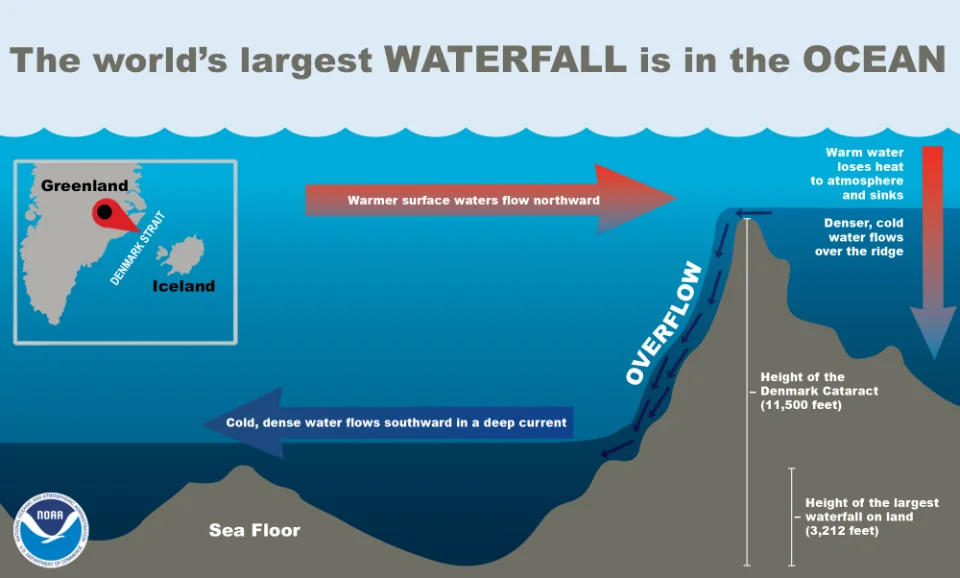
The Denmark Strait cataract is a flow of dense seawater over a ridge into deeper water. Cold and salt both affect density. It falls within the sea, not through air, so the useful picture is a moving layer crossing a threshold rather than a river plunging beside a dry cliff.
The sea has layers that need not weigh the same for the same volume. A cold layer can be dense enough to sink below a warmer one, with salt also part of the balance. A glass that looks clear and uniform is not a full model of that deep setting.
A seafloor ridge helps shape the descent
A seafloor ridge between Greenland and Iceland helps shape the ocean overflow. Dense water crosses the sill and descends on the deeper side. Channels, slopes, and mixing affect its route, so the flow is not one neat blue curtain with a sharp edge that a camera could simply frame.
A drawn wall of water is only a guide to the direction. Real flow spreads, stirs, and mixes as it goes. That makes the water around the descent part of the story, rather than empty space left outside a single clean path down a cliff.
Related Stories
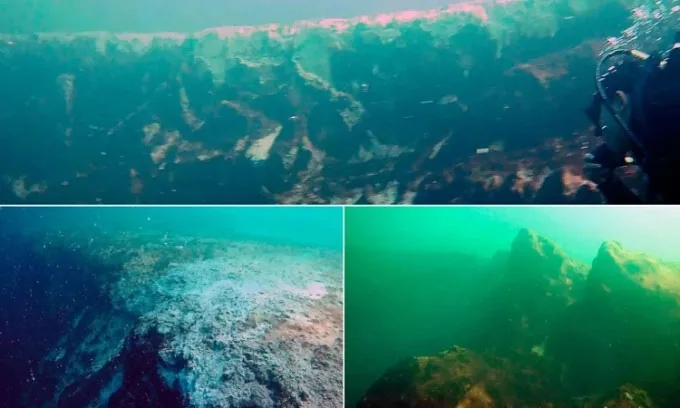

The largest numbers depend on what is measured
Descriptions of the cataract often emphasize its great vertical drop and large flow. Those figures need a definition of the route, depth range, and volume being compared. An underwater descent is not measured in exactly the same way as the free-falling part of a familiar waterfall on land.
A striking ranking can hide those choices. It is more useful to ask where the descent begins and ends, and whether a flow number includes water mixed in farther downslope. That approach keeps the scale impressive without turning unlike features into a simple contest.
Hidden flow helps supply deep ocean waters
Deep currents carry water, heat, dissolved substances, and other properties through the ocean. The overflow through Denmark Strait contributes to the larger circulation of the North Atlantic. Its role is part of a connected system, not a single pump that controls every distant current or weather pattern by itself.
Water that reaches deeper levels may travel far from the place where it first sank. Along the way it mixes and changes. Tracking those properties helps researchers connect a local passage with a much wider ocean that remains hard to observe directly.
Instruments reveal what a surface view cannot
Researchers study dense water using temperature and salinity sensors, current meters, ship surveys, and instruments left in place. Repeated records are key because flow varies. A calm sea above the strait does not prove a still ocean below, and one short visit cannot describe every season or long-term change.
The quiet surface is part of the wonder. A ship can cross a landscape of powerful motion without seeing a drop. Understanding it needs measurements through depth and time, turning separate points into a picture of water moving across a hidden mountain pass.
Frequently Asked Questions
No white spray rises from this waterfall because the flow stays within the sea. These questions follow water density, the ridge, and changes over time. The hidden motion is real, but the word waterfall should not make us imagine a dry cliff with one curtain of water falling through air.
Can a diver watch it like a normal waterfall?
Not like a river falling through air. The flow is deep and mixes with nearby seawater, so instruments give a clearer account of its structure than a scenic view from a boat or shore.
Is salt the only reason the water sinks?
No, Temperature and salt content both affect how dense the water is. Teams also need to consider depth and mixing when they trace layers and follow the flow into the deeper ocean.
Does the flow stay exactly the same all year?
No, the flow varies over time, so one visit cannot tell the whole story. Repeat surveys and long records help separate normal changes from a broader shift in the ocean system.