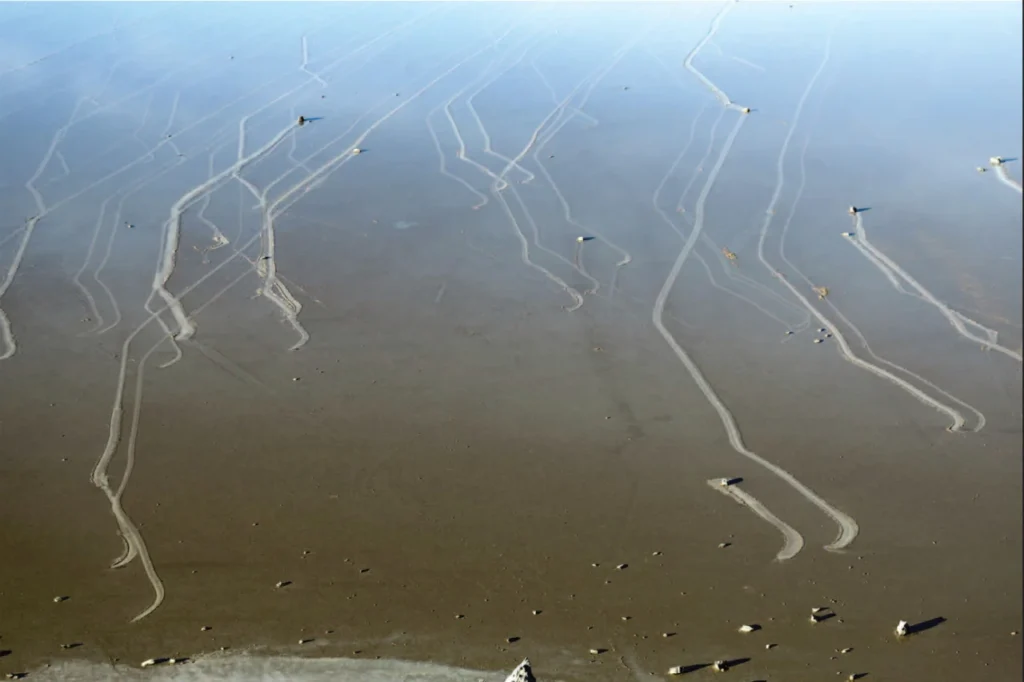
A stone rests at the end of a long trail across dry mud. No footprints follow it. No wheel marks explain it.
For years, Death Valley sailing stones seemed to offer the perfect desert mystery. The answer arrived through a scene that sounds less like a blazing desert than a cold pond.
The Clues Written Across the Ground
At Racetrack Playa, stones leave rock tracks across a flat lakebed that is dry much of the time. Some paths curve or run beside others. The trails show that movement occurred.
But they do not reveal the full sequence of weather and surface settings that made it happen.
A track can stay long after the pond dries. By the time most people arrive, the mud is hard and the rock is still. The scene has lost the water and ice that did the work.
That is why the dry ground can make a real event look so hard to explain.
Why a Desert Needed a Cold Night
Scientists observed a combination of shallow water, freezing nights, and thin ice. Water covered the ground while stones remained partly exposed. A delicate frozen sheet formed above the pool, then broke into floating panels as daytime warmth returned, preparing the surface for a small but effective push.
The ice need not lift a rock off the ground. A broad sheet gives the breeze a wide area to push. The hard part is the timing.
The pond must be deep enough for ice to float, yet low enough for the sheets to meet the stones as they move.
The Push Was Gentler Than Expected
Wind-driven ice panels could push stones over soft mud, leaving trails beneath the shallow water. Direct observations in 2013 helped show this process, with findings published in 2014. The measured movement was slow, which explains why an observer at a distance might miss it even while watching.
No hidden motor was at work. The team had to wait for a rare mix of common things: water, cold, sun, and wind. A stone moved so slowly that it was easy to miss.
A fixed point and a record of time helped make that small motion clear.
A Solved Process With Details Still to Study
The records explain a key way stones move at the playa. But scientists did not watch every stone or each event. Larger rocks and changing weather leave room for further work.
A scientific answer can identify a real mechanism without claiming that each track has been fully reconstructed.
The tracks are part of the place, not props for a photo. A foot pressed into wet mud can leave a mark for years. Moving a stone would break the link between it and its trail.
The best view leaves both where they are, ready for the next person to study.
Frequently Asked Questions
Most questions focus on wind, direct record, and how often movement happens. The key is the whole sequence, rather than one ingredient taken alone. A dry trail records a past event.
Meanwhile, the motion itself depends on a short-lived mix of water, ice, soft mud, and a breeze.
Do strong desert winds move the stones by themselves?
The observed events involved light winds acting on floating ice panels. Wind alone is not the full explanation for those documented movements.
Were the stones actually seen moving?
Yes, scientists straight observed movement in 2013. They combined records with instruments and reported the work in 2014.
Does this happen every day?
No, the required weather and water settings are uncommon. The trails last much longer than the events. So they are easier to find than moving stones.
Featured image: Richard D. Norris, James M. Norris, Ralph D. Lorenz, Jib Ray, Brian Jackson · Source · by/1.0. Resized proportionally and converted to WebP when downloaded. No crop.
