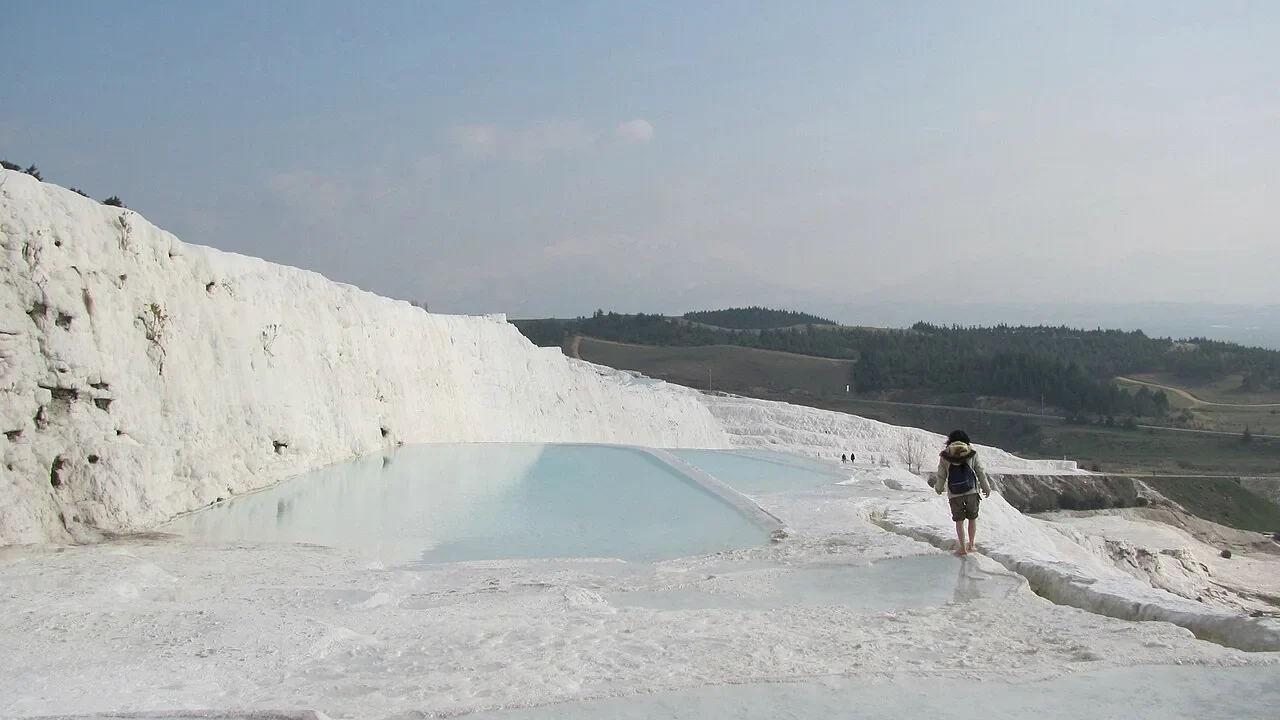
The white slope looks like a frozen waterfall left beneath a warm sky. Pale rims hold blue water in shallow steps, and the whole hillside seems too bright to be stone.
Yet heat, not winter, helped build this place. The whiteness arrived in water from below.
How Pamukkale terraces formed is a story of dissolved rock returning to solid form. In southwestern Türkiye, a flowing spring has been a builder as well as a source of water.
Warm water carries a hidden building material
The white steps consist largely of travertine, a carbonate rock left by spring water. Water brings dissolved rock to the surface, where shifts allow calcium carbonate to leave the solution. Thin deposits build pale slopes, rims, and pools that can look like banks of snow.
The best comparison is not a glacier melting slowly downhill. It is a stream leaving a little rock along its route.
A clear stream can carry something you cannot see. Here, that unseen load becomes the clearest part of the slope.
The water passes on while a thin record of its passage stays behind.
Escaping gas helps water become stone
Carbon dioxide loss helps shift the balance in thermal spring water when it reaches the surface. As gas escapes from the water, calcium carbonate can precipitate. The new mineral deposits build up where water flows, so the chemistry and the route of the stream together shape the growing rock.
The water does not turn into rock by itself. It brings bits of dissolved rock up from its path below ground.
Think of the spring as a delivery system. It brings material, releases some of it, and moves onward.
Heat, flow, and gas loss affect where the load forms a thin crust. Some of the load stays in the water.
Related Stories
Small edges guide the next thin layer
Travertine pools form on uneven ground as thin layers of rock build up. Water spreads across a rim, leaves deposits, and flows downhill. Old edges guide the next flow, while new routes shift the pattern, so the steps record slow growth rather than one sudden event.
A photograph freezes that process into tidy bowls. On the ground, some surfaces may be wet while others are dry, and not every pool looks equally full.
That mix is part of a working water system. The white stairway was not stamped from one mold.
It grows through small shifts, with one stream splitting, slowing, or finding a new path.
A city grew beside the springs
The Hierapolis ruins share the site with the pools, and people built a city around these odd springs. UNESCO recognizes the joint natural and cultural property. The remains of streets, buildings, burial areas, and a theater add human history to a place where spring water shapes the rock.
Warm springs drew people long before the first travel photograph. People approached them with beliefs, daily needs, and their own ideas about health.
To protect the place, we must watch both stone and flow. Roads, heavy use, and water management can affect what survives.
The white slope is hard rock. But the conditions that keep it unique are more fragile than its bright surface might suggest.
Frequently Asked Questions
The white slope makes more sense when snow, salt, and concrete are set aside. These steps are mineral deposits built by flowing spring water, with carbonate chemistry doing the work. The nearby city belongs to the same heritage site but did not build the natural slope.
Is Pamukkale covered in snow?
Its white surface is mostly travertine, not a fixed cover of snow. Spring water has left layers of carbonate rock across the slope over time.
Is the terrace water always blue?
Its appearance shifts with depth, lighting, flow, and the surface beneath it. A photograph taken under one set of conditions should not be treated as a fixed color chart for every pool.
Did old builders carve all the pools?
The main terrace shapes form from natural deposition and flowing water. People and their use of water have changed the site.
But the white landscape is not simply a set of old, built baths.