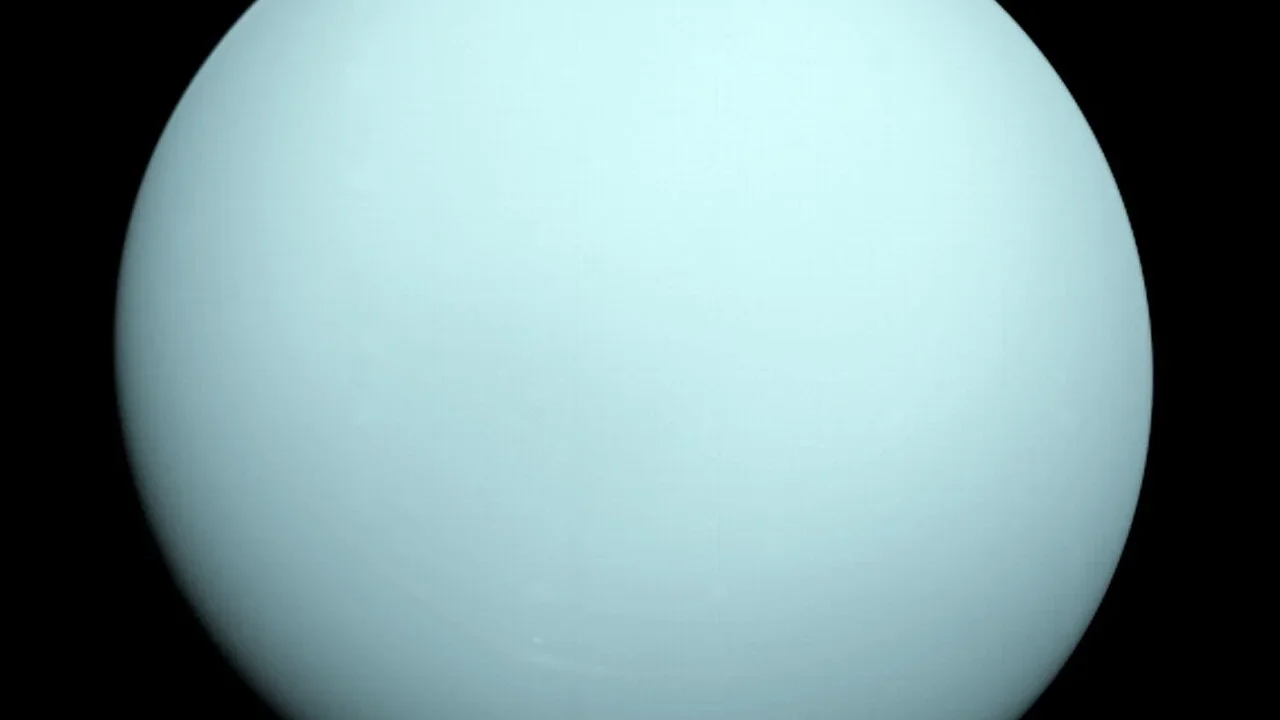
On Uranus, the poles take turns facing the Sun through seasons that last for years. The planet does not stand upright like a classroom globe.
Its axis lies so far over that the whole world seems to roll along its path around the Sun.
Why Uranus spins sideways is a question about a very old event. We can measure the strange result now.
But rebuilding its cause takes more than pointing at one striking collision.
A tilted axis rewrites a year
Uranus has an axial tilt of about 98 degrees, making its spin odd among the major planets. Its axis keeps a broadly consistent direction while the planet travels around the Sun. As a result, sunlight reaches distinct latitudes in a strongly changing pattern over its long orbit.
An axis is an imaginary line through the poles. It is not a rod passing through the planet, and a tilt does not mean the orbit itself stands on edge.
That distinction helps the picture make sense. The planet follows its path while the direction of its spin produces the odd angle.
Rotation and travel are related motions. But they are not the same motion.
Summer can face a pole
Uranus seasons are extreme because the planet takes about 84 Earth years to orbit the Sun and its axis is strongly tilted. Near a solstice, one polar region faces long sunlight while the other faces long darkness. Near an equinox, the Sun shifts closer to the planet’s equatorial view.
The simple phrase “42 years of day” can mislead if applied to every place. Latitude and the stage of the orbit matter, and conditions near the equator differ from those at a pole.
Seasonal light also does not make this distant world warm like a summer beach. Uranus stays a cold ice giant with an atmosphere very distinct from the air around us.
Related Stories

A collision may be the cause
The giant impact hypothesis proposes that a major collision helped tip Uranus during planet formation. Such an event could shift a young planet’s spin. Research teams test possible histories against more than tilt alone, because a successful answer must also fit the planet’s other known traits and the nearby system.
This is a reconstruction, not a witnessed crash. Research teams shift starting conditions in models and compare the outcomes with the clues we have today.
A model can reveal what might work without proving which event happened. Several processes may leave similar marks.
The strongest idea must survive comparisons, rather than merely making the most memorable animation of a planet being knocked over.
The quiet disk hides a hard problem
The Voyager 2 flyby in 1986 gave research teams a close look at Uranus, its atmosphere, moons, and rings. Later views added new detail, but a short visit cannot record an old impact. Understanding the sideways world needs joining readings from distinct times with models of its deep past.
Visible light shows a pale globe. It does not give us the clear ground maps we can make of a rocky world.
Clouds hide the layers below, where much of its history may be stored.
That makes Uranus a useful lesson in planetary science. A feature can be plain to see while its cause stays hard to show.
The sideways spin is a clue; the route that made it is still the search.
Frequently Asked Questions
Uranus spins on a steeply tilted axis, but the rolling-ball image is only a guide. The planet touches no surface and follows no literal track. Its seasons depend on both the direction of its axis and the long time it takes to circle the Sun.
Is Uranus completely upside down?
Its tilt is about 98 degrees from the usual upright reference. That puts it slightly beyond sideways, so “upside down” alone does not describe the geometry very well.
Did a collision for sure tip Uranus?
A large impact is a key possible answer. It stays a hypothesis about the planet’s history, rather than an event directly seen or uniquely proved by the tilt alone.
How long is one season on Uranus?
A rough quarter of its 84-year orbit is about 21 Earth years. The experience at a given place depends on latitude and how sunlight shifts throughout that interval.