A bead of rain slips across a leaf and takes a speck of dirt with it. No soap appears. No hand wipes the green surface.
Lotus effect explained starts with that small scene, where a leaf's fine texture turns a passing shower into a useful cleaning tool.
The leaf is rough in a very small way
A lotus leaf looks smooth from a distance. But its surface has tiny raised features covered with wax; these combine to limit how closely water touches the leaf; the waxy surface matters. Yet the shape beneath it also helps a drop stay round instead of spreading flat.
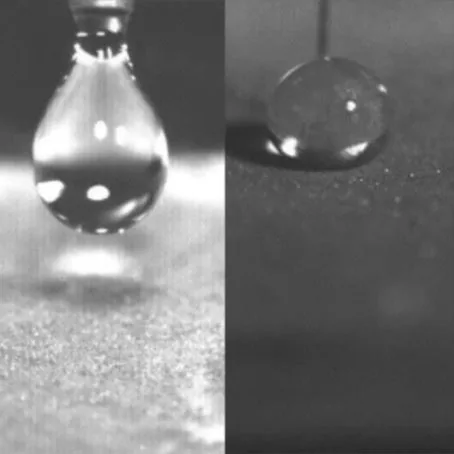
Think of a drop resting on the tops of many small bumps. Air can remain in the gaps below. The result is not a loose plastic sheet over the leaf.
But a living surface whose fine structure changes how water meets solid matter.
A round drop can carry dirt away
Water droplets can roll across a tilted lotus leaf and collect loose dirt along their path. The dirt sticks to the water more readily than it remains attached to the leaf. As a drop leaves the edge, some of the material it picked up leaves with it.
This helps explain why rain can clean such a surface rather than merely wet it. A broad smear of water behaves differently from a moving bead. The bead keeps a clear edge that can meet particles as it travels over the leaf.
Related Stories


Shape and chemistry work together
Surface texture and water-repelling chemistry both affect the result. Contact angle describes the shape a resting drop makes where it meets a surface. A high angle can signal strong water repellence, but easy rolling also depends on whether the drop's edge becomes pinned in place.
Two materials can produce round drops and still shed them at different speeds. Scratches, dust, and small defects can catch an edge. A good test therefore checks how a drop moves, not just how striking one still photo makes it look.
Engineers borrow the trick with limits
Self-cleaning coatings aim to use similar principles on glass, fabrics, and other materials. A surface may shed rain and loose dust well while still struggling with oil, abrasion, or sticky grime. A successful lab sample must also survive use, cleaning, sunlight, and changes in the weather.
That gap between a fresh sample and a working product matters. A window faces grit and wiping cloths. A coat bends and rubs against straps.
The best design must keep its useful texture after these ordinary events, rather than only on the first day.
Not every self-cleaning material copies a lotus
The phrase self-cleaning covers several different methods. Some surfaces repel water, while others spread it into a thin film or use light-driven chemistry to break down certain dirt; the right explanation depends on the material. So a lotus comparison should not replace a description of how it works.
A clear claim names the task: shedding rain, reducing fog, or helping wash away dust. None of these means a surface stays spotless forever. The leaf offers an elegant starting point, but useful engineering still has to meet a specific real-world need.
Frequently Asked Questions
The most useful questions concern rolling drops, loose dirt, and wear. The lotus effect is a surface process, not a promise of perfect cleanliness. Its value comes from matching a fine texture and suitable chemistry to the kind of water and dirt a surface will actually meet.
Does the lotus leaf use soap?
No, its texture and wax help water bead and roll. Moving drops can lift some loose particles and carry them off the leaf without a detergent being added.
Does a large contact angle prove a coating works well?
It shows how a drop rests on the surface. A practical test also checks how easily the drop moves and whether the effect lasts after wear.
Can a lotus-style coating repel every liquid?
No, Oil and other liquids can behave differently from water. A product's claims need testing with the actual liquids, dirt, and working conditions it is meant to handle.