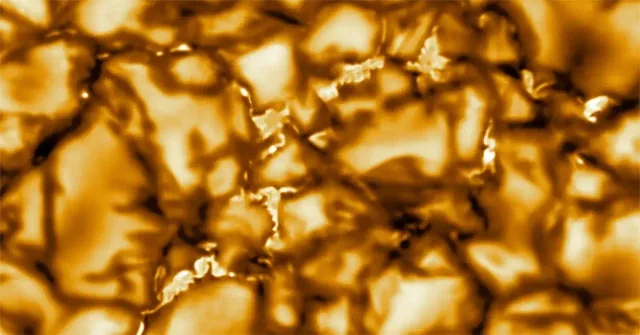
The Sun's surface looks like a field of golden cells, each bright center enclosed by a dark border. The pattern shifts instead of sitting still. Solar granulation images reveal moving heat in a place that seems smooth from Earth, turning a familiar disk into a landscape of rising and sinking gas.
The pattern comes from the Sun's visible surface
The photosphere is the layer from which much visible sunlight escapes. It is not a solid shell with cracks between hard tiles. Close images show hot gas and fields at work, revealing a moving pattern where a normal view from Earth offers only a smooth-looking bright disk in the sky.
A close view changes the question from what shape the Sun has to what makes its surface look that way. The texture is evidence of motion and heat, not just a more detailed version of yellow paint on a ball.
Heat rises and the pattern continually changes
Bright granules often mark hotter material rising, while dark lanes mark cooler material sinking. This is linked to convection, which carries heat through moving matter. The brightness still depends on the light being measured, so the pattern needs to be read with the wavelength and image method in mind.
A boiling pan gives a rough hint of rising and sinking, but it is not a full model of the Sun. Hot plasma and strong fields add other effects. Use the kitchen image for one useful idea, then let the data guide what the real star is doing.
Related Stories


Fine detail does not mean small features
Image scale links what fills the screen with distance on the Sun. Granules can span roughly a thousand kilometers, though their sizes vary. A small patch in a phone image can therefore hold huge features, and a scale bar is needed before a close view can be judged as tiny.
What looks like a small cell can be wider than a long trip across land. The exact comparison is less important than the habit: read the scale before deciding what the beautiful texture says about the size of the things in it.
Color should be read with the observing method
Solar images may use assigned colors or a narrow range of light. A gold or red hue does not always copy what a human eye would see. The method explains how the data became a visible picture, helping readers judge the view without mistaking useful processing for a fake.
Color can make weak features clear or separate one set of data from another. It is not whether every useful science image must look like a daylight photo taken from the ground with a normal camera and no processing at all.
A sequence reveals what one beautiful frame cannot
A sequence shows granules growing, fading, and changing shape, not remaining fixed like tiles. Motion helps connect the view with heat flow beneath it. Other measurements, including magnetic data, add clues that brightness alone cannot provide, so one lovely frame should not be asked to explain the surface by itself.
Check the time span, the image scale, and the wavelength. Those three details turn a striking view into an observation you can read. The real wonder is a star in motion, not a decorative skin, and a short sequence can make that much clearer than one still picture.
Frequently Asked Questions
The Sun's pattern is hot gas in motion, not a set of solid tiles. These questions focus on color, scale, and safe viewing. They show how a close image can be read as data without treating it as a normal photograph or a guide to looking through a telescope.
Are the dark lines cracks in a solid surface?
No, they mark differences in moving gas, not cracks between hard blocks. The view shows a flowing layer, even though a still frame can make the bright patches look like a solid mosaic.
Are the colors always natural?
No, a narrow range of light or assigned colors may be used. Check the method before reading the hue as the exact view a human eye would get in an ordinary daylight photograph.
Is it safe to try seeing this through binoculars?
Never with ordinary binoculars or a telescope. Looking at the Sun that way can cause severe eye injury, so solar viewing needs properly designed equipment and safe procedures suited to the instrument in use.