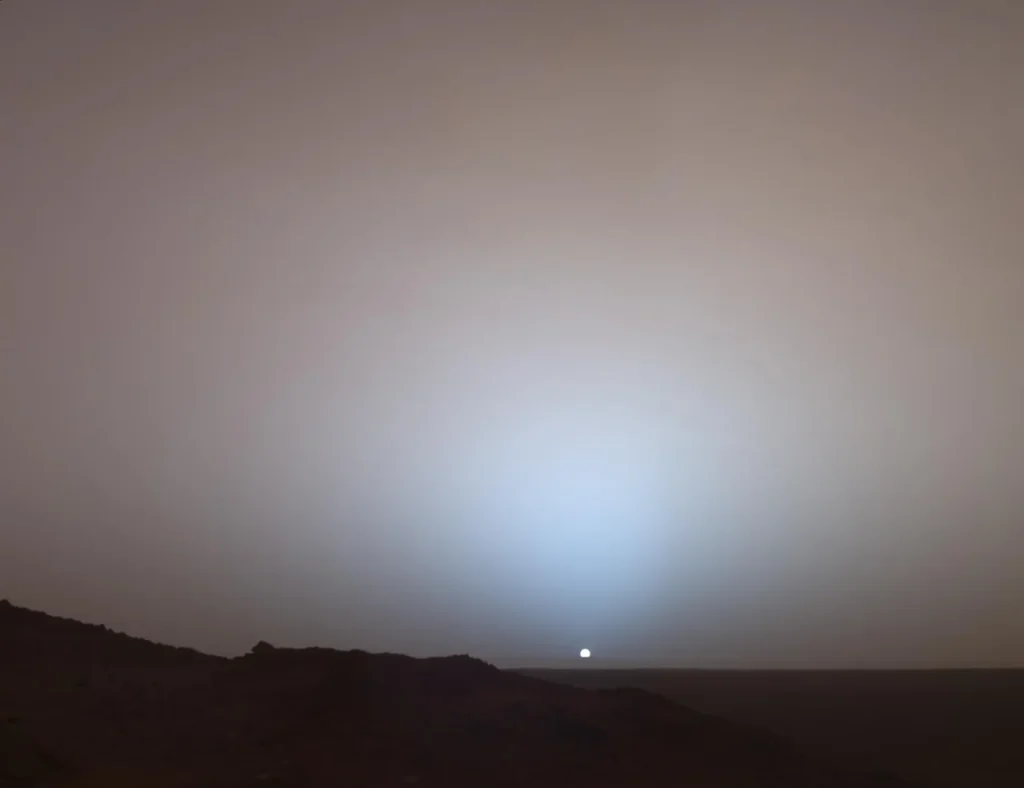
A pale Sun sinks toward a dusty ridge, and a blue glow gathers around it. On a planet named for its red look, dusk can look unexpectedly cool. Why are Mars sunsets blue?
The surprise comes from fine airborne dust changing the routes taken by distinct colors of sunlight.
Dust Changes the Path of Sunlight
Martian dust interacts with sunlight in a way that can concentrate blue light near the Sun's direction during twilight. Other colors spread differently across the sky. The result is a local bluish glow, not a claim that every part of the atmosphere becomes blue or that each sunset matches.
Dust grains do not treat light just as tiny gas molecules do. Size matters. So a simple rule for Earth’s blue sky cannot be copied to Mars without a check.
The dust changes which rays stay near the Sun’s direction, and that is where the blue glow becomes most clear.
A Red Planet Can Have Blue Twilight
Mars looks red largely because iron-bearing surface material has oxidized, making a rusty look. Blue twilight concerns light scattering in the atmosphere, a distinct process from surface color. A planet's ground and its sunset therefore need not share one dominant color, even when both appear in one rover photograph.
Earth has a blue sky above green woods and brown soil. It can still have a red sunset. Mars has its own mix of ground, air, and viewing angle.
The colors do not need to match, because they come from light meeting different things along different routes to the eye.
What Spirit Saw at Gusev Crater
The Spirit rover recorded a sunset near Gusev crater on May 19, 2005. NASA explains that the blue glow near the Sun would be visible to an observer. The image's filter combination also affects other colors, reminding readers that a scientific camera is not an exact copy of human vision.
A rover sees through filters. A team then builds an image from those records. Some choices reveal details while changing the look.
The caption helps you tell what is close to a human view and what has been enhanced. Neither kind of image should be judged by color alone.
Why Different Sunsets Can Look Different
Dust levels, clouds, geometry, exposure, and image processing all influence how a sunset is recorded. One photograph cannot define every evening on Mars. The broader finding is that fine dust can make the characteristic blue region near the Sun, while local settings and camera choices change details of one view.
The scene still feels familiar: a ridge darkens, the light thins, and a day ends. A different shade does not make the physics strange beyond reach. It gives a clue.
By tracing the light, a team can learn how the air shapes what a person might see from that distant ground.
Frequently Asked Questions
The main questions concern the blue region, whether water is involved, and how cameras represent the scene. Each is answered by separating the physical event from the recorded image. A real blue glow can coexist with color processing, and neither should be confused with evidence of a blue ocean.
Does the entire sky on Mars turn blue at sunset?
Not necessarily. The characteristic blue glow is strongest near the Sun. Meanwhile, other parts of the sky can retain distinct colors.
Is blue twilight proof that Mars has oceans?
No, the glow is explained through atmospheric dust and sunlight. It does not need oceans reflecting a blue color into the sky.
Do rover sunset images show exactly what human eyes would see?
Not always, because filters and processing affect the result. NASA captions explain which colors are roughly visible and where the camera introduces differences.
Featured image: NASA/JPL/Texas A&M/Cornell · Source · public-domain. Resized proportionally and converted to WebP when downloaded. No crop.