

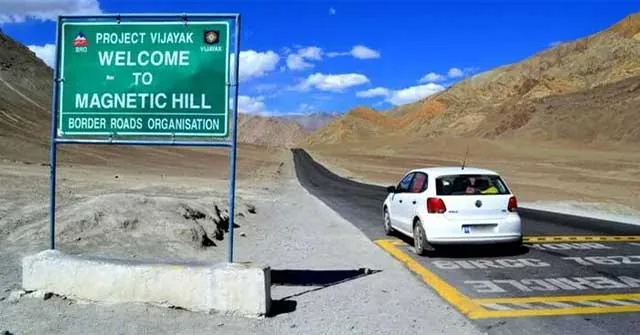
A car seems to roll uphill with its engine off. Water appears to run the wrong way, and a bottle joins the trick. The gravity hill illusion is compelling because gravity has not changed at all; the surrounding scene has changed the way the slope looks to the observer standing on it.
The road descends while the view suggests otherwise
At a gravity hill, the road can slope down while the scene makes it look uphill. A rolling object still moves toward lower ground. The trick lies in judging the slope from misleading surroundings, not in gravity reversing on one short stretch of road while acting normally everywhere around it.
The true horizon may be hidden, while a tilted ridge feels level. A small road slope is then easy to read backward. The mind uses the whole scene as a guide, so the mistake can feel certain even though a careful height measurement tells a different story.
The horizon is a reference the eye often borrows
A false horizon may come from slopes, ridges, trees, or other features that suggest the wrong level line. The road is judged against that borrowed guide. Knowing the cause need not remove the illusion, because factual knowledge and the brain's first reading of a view do not always change together.
You can know the answer and still feel the trick. That is not a sign of foolishness. The view continues to supply the same wrong guide, much as a drawn illusion can keep looking odd after someone explains how its lines fool the eye.
Related Stories


Different objects can expose the same mistaken slope
Rolling objects and flowing water can share the apparent uphill path because they share the downhill slope. The match does not prove a force acts only on cars. It can support the simpler account that normal objects follow gravity on ground whose angle the viewer has misread from the scene.
But a suitable nonmagnetic object may show the same effect. The name is a clue to the site's fame, not proof of the physics.
Measuring height gives a different kind of evidence
Survey measurements can compare height without relying on the view. A suitable level can show which end is higher. A phone or casual map may help, but the readings must be precise enough for a gentle slope before they are treated as proof that the road rises or falls.
A rough number can add a second mistake rather than fix the first. Repeat the reading with a sound setup, or use a professional survey, and the ground can be checked without asking the same misleading view to judge itself again.
A roadside attraction still needs ordinary road safety
The effect should not be tested by letting a car roll onto a live road or standing in traffic with a bottle. Local rules and safe viewing arrangements matter. A curious slope is not a reason to give up control of a vehicle or create danger for people approaching unseen.
A site may offer a safe way to see the effect. The lesson is the same without a risky home test: the road follows ordinary gravity, while the view changes our judgment. The memorable part is a direct glimpse of how strongly a background can shape what we feel sure we see.
Frequently Asked Questions
The road slope and the visual reference are separate parts of the trick. These questions ask which way the ground really falls and why the view may disagree. A strong first impression or a sign saying Magnetic Hill is not a substitute for height measurements made with a suitable method.
Is the car really moving uphill?
At a typical gravity hill, it rolls downhill even though the view suggests otherwise. Measured heights test the slope more directly than the scene that created the misleading impression in the first place.
Why can water seem to do the same thing?
The same view can make water's downhill route seem uphill. A similar effect with water or nonmagnetic objects is a reason to test the slope rather than assume that a magnet pulls only cars.
Does knowing the explanation remove the illusion?
Not always. The scene still supplies the same misleading clues, so it may keep looking wrong. Knowing the cause changes what we conclude without forcing the eye to stop seeing the illusion at once.





