

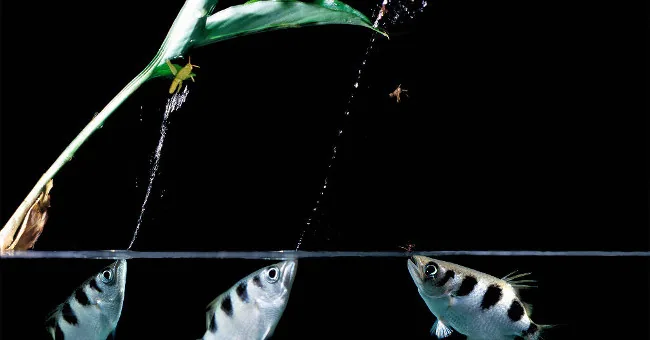
An insect rests on a leaf above the water. Below, a fish aims. A jet flies up, and the prey falls toward its hunter.
How archerfish aim joins sight, learning, and flowing water in one quick act. The shot crosses two worlds, but landing the meal takes more than a good hit.
The fish hunts across an optical boundary
Light refraction bends a ray as it crosses between air and water. An insect above the surface can therefore appear shifted to a fish below. Archerfish cope with that viewing problem, though the angle and position change the task, so one fixed correction is not a account of every shot.
Looking straight up is not the same as looking far across the water. The shift changes with the angle. A useful account follows that geometry and the fish's behavior, rather than assuming it applies one simple rule that must fit every target from every place in the pool.
A narrow jet turns the mouth into a tool
Mouth shape and controlled movement make a directed water jet. It strikes insect prey and can knock a meal from a perch. The action is more than a random splash, and tests can study how the fish adjusts its aim and stream when the target or its position changes.
Water carries the fish's push across the gap. That extends its reach into air while its body stays in water. The aim is only useful if enough force reaches the insect, so the stream itself belongs to the skill, along with the eye that first finds the prey overhead.
Related Stories

The stream can change as it travels
The speed and timing of water leaving the mouth help shape the stream's impact farther away. Jet structure affects how much force reaches a target. Slow video can reveal this sequence, while a still image shows only one moment and cannot explain the whole strike.
The fish must get water to the right place at the right time, not just launch it generally upward. Fluid motion becomes part of the animal's practical skill, alongside the eye that first detects a worthwhile target.
Experience can improve a difficult shot
Hunting accuracy changes with experience and task conditions. Controlled tests show that archerfish can learn and adapt their performance. This does not establish that they consciously solve optical equations, and a successful laboratory trial should not become a claim of perfect aim in every wild encounter.
A missed shot has effects beyond pride. It may waste effort, alert prey, or let another fish collect the reward. Learning useful relationships between target position, water, and movement can therefore matter in a setting where the hunter rarely has unlimited time to practice.
Knocking prey down is only the first half
Once prey falls, the fish must reach it before competitors do. The landing point depends on the fall and local conditions. A successful hunt combines the shot with a rapid response afterward, making the whole behavior more demanding than the moment when water strikes an insect.
Watching only the strike leaves out that second skill. The hunter may move as the prey drops, turning a distant target into a short race at the waterline. The result is a feeding strategy built from several linked actions, each helping the next one succeed.
Frequently Asked Questions
The hunt crosses a boundary that bends light, then becomes a race for food. These questions follow the view, the shot, and the falling target. They show why a skilled fish need not hit every time, and why one still frame cannot reveal the whole hunt.
Does refraction make the insect appear in a different place?
Yes, Light changes direction at the air-water boundary, so the insect can appear shifted. The size of that effect varies with the viewing angle, which changes the aiming task from one shot to another.
Do archerfish hit every shot?
No, Experience, target, and conditions affect the result. The skill is striking because it works well at a hard task, not because a fish is certain to hit every target in the wild.
Why swim quickly after the insect falls?
Other fish may reach the same prey first. Knocking it down is useful only if the hunter can collect it, so the quick movement after the strike is part of the successful feeding strategy.





