

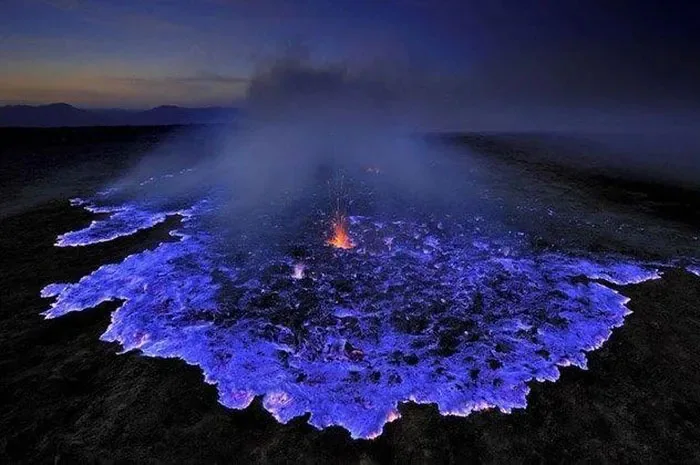
Blue light seems to run down a volcano after dark, as if someone changed the rules for lava. Photographs from Ijen in East Java can look almost unreal. Yet Ijen blue fire explained by chemistry begins with a simple correction: the famous blue glow comes from burning sulfur, rather than a river of blue molten rock.
The color belongs to a flame
Ijen's blue flames appear when sulfur-rich volcanic gases burn after meeting oxygen. The hot gases escape through cracks near the crater, and burning material can create the impression of a glowing flow. The effect is easiest to see at night, when daylight no longer overwhelms its much fainter blue light.
Burning sulfur produces a blue flame under suitable conditions. That does not change the usual color of hot lava, which depends strongly on temperature.
A photograph may merge separate bright patches into a flowing ribbon. Reading the image correctly means asking what is burning, what is liquid, and which parts the exposure has made more visible.
The crater contains more than a dramatic glow
Volcanic gases rise in a landscape that also contains an acid crater lake and sulfur deposits. Heat, water, and gases interact in this system, producing conditions very different from an ordinary mountain lake. Its striking appearance comes from active processes.
The acid crater lake is a separate feature from the blue flames, even though images often present them together. Confusing the two can turn a real chemical setting into an inaccurate story about luminous water.
Related Stories

Darkness changes what the eye can notice
Blue flames can be present without being equally visible at every hour. In daylight, bright surroundings compete with their light. After sunset, the same emission stands out against dark rock, while camera exposure and processing can strengthen the effect further and alter the balance between flame, smoke, and background detail.
The most honest caption describes the observed phenomenon and the conditions of the image. It does not claim that every blue area is lava or that the landscape always looks this way.
The human work beside the vents matters
Ijen's sulfur workers belong in the story alongside its colors. Their labor involves difficult terrain and hazardous gases, not just a dramatic backdrop. Photographs need human context and accurate captions, so the spectacle does not hide the work and exposure involved in collecting and carrying sulfur.
Photographs of workers should be treated as records of people, rather than props in a mysterious setting. Names, dates, and accurate context improve the account where available.
The setting does not need a supernatural explanation to be extraordinary. The meeting of volcanic heat, chemical reactions, and human work already gives it a powerful story.
A striking image should lead to better questions
The flames, gases, lake, and deposits share a volcanic setting but have different explanations. Separating them prevents the false claim of blue lava. A good image description identifies what emits the light, what is liquid, and how darkness or exposure changes the view the camera records.
East Java's famous glow is a reminder that color alone does not identify a substance. The light catches the eye first. Chemistry explains what the eye has caught.
A false-color map, an edited photo, and a real blue flame are three distinct things. Keep the image's label when sharing it.
Frequently Asked Questions
Questions about Ijen often mix together lava, sulfur, and the crater lake. These are connected parts of a volcanic system, but they should not share one explanation. The answers below concern the famous blue-fire phenomenon, rather than every colored feature that might appear in a photograph of the wider mountain.
Is the lava at Ijen really blue?
The famous blue light comes from burning sulfur-rich gases and related burning sulfur. It is not evidence of blue molten rock flowing down the mountain.
Why do most photographs show it at night?
The flames stand out better against darkness. Daylight can make the same light much harder to see, while a long exposure can emphasize it.
Is the blue glow a sign of safe air?
No. A beautiful flame does not indicate safe conditions, and volcanic gases can be hazardous. Access depends on local authorities and current volcanic conditions.





