

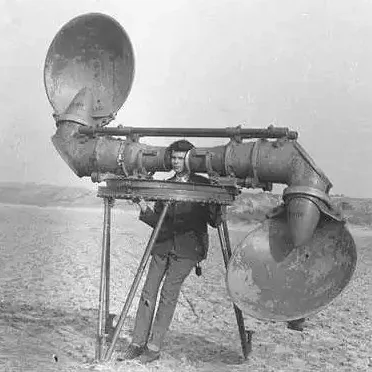
Before radar, a warning could begin with someone listening toward the sea. Large concrete curves on Britain's coast gathered faint engine noise and directed it toward a receiver. Acoustic mirrors explained through sound reveal a serious attempt to make distance audible, using a landscape that now looks more like sculpture than military equipment.
A curved surface can gather sound
A curved concrete surface can gather engine sound toward a listening point. Its shape and receiver position both matter. Acoustic mirrors used this principle to aid aircraft detection, but the structures differed in size and design, so they should not all be treated as identical devices.
A person did not simply stand anywhere beside the concrete and hear farther. The receiver's position mattered because the reflector concentrated sound toward a particular region.
Different designs explored different arrangements. A small dish and a long curved wall could share the broad aim of gathering sound without working in precisely the same way.
Detection depended on more than the mirror
A mirror alone could not identify and plot every aircraft. Operators needed listening gear, judgment, and a way to pass warnings onward. Noise and weather affected the signal, making the reflector one part of a larger system rather than a fully automatic detector.
The story becomes clearer when the listener remains in the picture. Human attention and judgment were essential parts of the technology, alongside the impressive shape of the reflector itself.
Related Stories



Sound gave warning only after a delay
Sound travels far more slowly than radio waves, so an approaching aircraft had already moved while its engine noise crossed the distance to a listener. Faster aircraft reduced the warning time. This delay limited acoustic systems even if a reflector gathered the sound well and an operator interpreted it correctly.
These limits were physical, not simply a failure of effort. Better equipment could improve detection, but it could not make sound arrive as quickly as an electromagnetic signal from the same distance.
Radar changed the early-warning problem
Radar uses reflected radio signals rather than engine sound. It could detect and locate aircraft without waiting for their noise to arrive, addressing a basic limit of acoustic warning. The new method still needed skilled people, reliable equipment, and a working system for interpreting results.
The transition was not a magical overnight replacement of every older tool. Technologies develop through testing, deployment, and integration with other systems.
Acoustic mirrors now make that change visible. They preserve a moment when one promising approach met the limits of a faster-moving world and a different method became more useful for the task.
The surviving structures record an experiment in scale
A coastal acoustic mirror is best understood as a physical experiment made large enough to work. Its curves reveal an attempt to direct invisible waves using concrete and geometry. The remaining structures are historical evidence, and their dates and purposes should be checked individually rather than assigned from appearance alone.
Some images of early aircraft listening devices show horns worn or operated by people. Those are related to the same broad problem, but they are not all concrete acoustic mirrors.
The name can also mislead. These devices did not send a sonar pulse into the sea to find a submarine. They listened for sound already made by an aircraft.
Sound detection used concrete reflectors to gather noise from aircraft engines for early warning, before radar history took a different turn.
Frequently Asked Questions
The common questions mix acoustic mirrors with other listening devices and sometimes describe them as a form of radar. These answers separate the shared aim of detecting aircraft from the different physics involved. A historical account checks the site, since surviving structures do not all have identical designs or dates.
Were acoustic mirrors an early kind of radar?
No. They gathered sound, while radar uses radio waves. Both could support warning, but they relied on different signals and faced different physical limits.
Could they hear an aircraft instantly?
No. Engine sound took time to reach the receiver, and the aircraft moved during that delay. Faster aircraft made that limitation more important.
Why were they built near the coast?
Coastal sites could face likely approaches and offer a listening direction across open water. The usefulness of a particular location still depended on its geography and conditions.





