

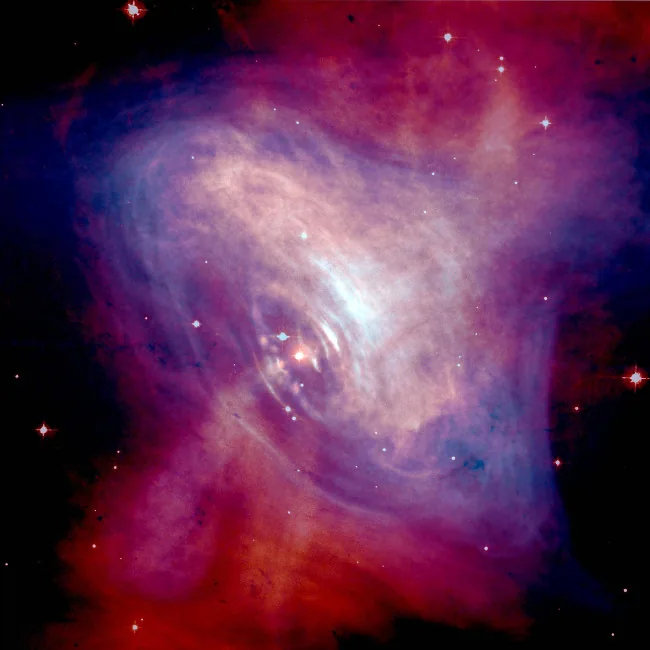
A radio receiver records a beat from the sky, then another, with a steadiness that seems almost built. The source is a dead star still turning. How pulsars work is a story of spin, strong fields, and a narrow beam that reaches us only when the geometry is right.
The pulse comes from a turning star
A pulsar is a rapidly rotating, strongly magnetized neutron star whose emission reaches us in repeating pulses. The star itself does not need to expand and shrink with each beat. Much of the pattern comes from its spin carrying a beam across our line of sight.
A lighthouse beam offers a useful picture. Its lamp may shine steadily. Yet a person far away sees flashes as the tower turns.
Space adds much more complex physics. But the simple change in viewing angle explains why a regular beat can come from rotation.
Collapse leaves a remarkably compact remnant
A stellar remnant can form when the core of a massive star collapses after it runs out of fuel that supports it. In a neutron star, matter is packed into a body only about the size of a city. Its small size goes with a huge mass.
Do not picture an ordinary star squeezed into a hard ball by an outside hand. The collapse changes the state of matter itself. Gravity, dense nuclear matter, and extreme pressure create conditions that are far beyond those found in a familiar piece of rock.
Related Stories



Magnetic and spin axes need not line up
The magnetic poles need not point along the star's rotation axis; Emission linked to the magnetic field can therefore sweep through space as the star turns. We detect radio pulses only if some of that emission crosses Earth. So not every neutron star appears to us as a pulsar.
The lighthouse beam comparison also has this limit. A lighthouse can be present beyond a headland without its beam reaching your window. Likewise, absence of a pulse from our viewpoint does not prove that a compact star lacks rotation or a strong magnetic field.
A changing beat can reveal an unseen companion
A pulsar's rotation period can be measured with great care. Changes in pulse arrival times can reveal motion in an orbit, loss of spin energy, or other effects along the signal's path. The meaning depends on a model and repeated measurements, rather than on one unusually late pulse.
When a star moves toward us, its pulses arrive differently than when it moves away. That shift can help reveal a companion too faint to see directly. Timing becomes a way to study a system whose most useful clue is a sequence of arriving signals.
A natural clock is useful without being perfect
Some pulsars give very stable timing. But they are not flawless clocks; Sudden changes in spin, long-term slowing, and the space between source and receiver all affect the record. Researchers account for these effects before using pulsars to test gravity or study other questions about the universe.
The first step is patient comparison. A real sky signal must be separated from faults and local interference. That care is part of what makes the result striking: a small trace on a screen can point toward matter, motion, and gravity far beyond our reach.
Frequently Asked Questions
A pulse tells us about both the star and our view of it. These questions keep the spinning body apart from the light beam that sweeps past Earth. A star may be active even when its beam misses us, as a lighthouse can shine beyond the view from one window.
Is a pulsar a separate kind of planet?
No, the pulsing source is a dense neutron star, not a planet. Some such stars have planets around them, but those worlds are not what makes the regular beam sweep past Earth.
Are the pulses messages from aliens?
A steady beat is not enough to show a message. Many tests link these signals to spinning stars and their fields, giving a natural account that can be checked against the data.
Do all pulsars flash at the same speed?
No, Their spin rates span a wide range and can change. A star's past, loss of energy, and nearby companion can all affect the timing of the pulses that we receive.





