

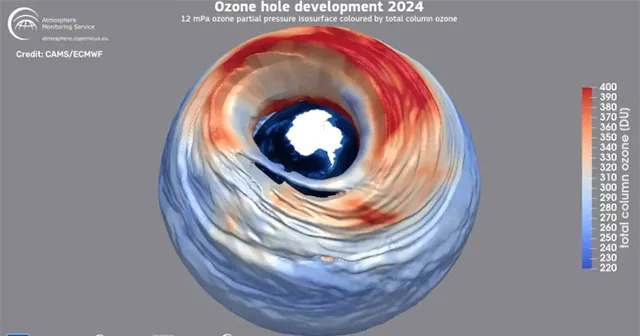
Each southern spring, a dark patch returns to maps of ozone above Antarctica. It can look as though years of repair have failed overnight. Ozone layer recovery is slower and less tidy than that image suggests, because a long-term chemical change unfolds inside a sky that still has seasons.
The hole is a thinning layer rather than empty space
Stratospheric ozone blocks much of the Sun's harmful ultraviolet light. The hole above Antarctica is a thin patch of that gas, not a gap with no air. Teams measure how much ozone is there, so a dark patch on a map shows data rather than empty space.
The dark patch on a map is not a hole you could put a hand through. It marks a low amount of one gas. Air is still there.
Reading the colors as data, not as a torn lid, makes the rest of the story much easier to follow.
Old chemicals can remain active for decades
CFCs and some other gases can stay aloft for a long time. Sunlight can help them release chlorine or bromine that harms ozone. Cutting new use is vital, but it does not clear the old gas at once, so the sky needs time to respond.
A rule can stop new sales without clearing old gas from the sky. Some stock also stays inside old cooling gear. Good care at the end of that gear's life helps prevent more gas from escaping, while the load already aloft takes time to fall.
Related Stories

Polar winter prepares a special chemical setting
Polar clouds form in the very cold upper air and help prepare the chemistry that harms ozone. Cold air can stay trapped through winter. When light returns in spring, loss can speed up, even while the amount of harmful gas declines over a much longer span.
Cold air stays apart from the warmer air around it, and the clouds help prepare the chemical change. When light returns, the loss can speed up. A warmer or less stable year can give a different result from the same broad process.
Recovery is judged across many years
The Montreal Protocol cut the use of many gases that harm ozone. Teams judge its effect with long records, not just one year's hole. Weather can make one season better or worse, so a single large patch does not by itself prove that the long-term repair has failed.
One year is one page, not the whole book. Teams follow both the ozone and the gases that harm it. They ask whether long records fit what the chemistry predicts.
That is a stronger test than choosing one small hole as proof of success or one large hole as proof of failure.
Ozone protection and climate protection overlap without being identical
Ozone layer recovery and climate change are linked, but they are not the same problem. One concerns a shield against ultraviolet light; the other concerns Earth's heat balance. Some gases affect both, yet progress on one issue does not mean every part of the other is solved.
The same gas can play different roles in different places. High ozone helps block harmful rays; ozone near the ground can harm lungs and plants. Nor does healing the high layer solve every climate problem.
The place and process need to be named before two claims can be compared.
Frequently Asked Questions
The springtime hole can return while the long-term trend improves. These questions follow old gases, cold air, clouds, and sunlight to show why. One map is useful, but it cannot tell the whole story of a layer whose repair takes much longer than a year.
Why can the hole return if harmful chemicals were restricted?
Many of those chemicals persist for a long time. Polar conditions can still activate the chlorine and bromine that remain, producing strong seasonal depletion while their overall abundance gradually declines.
Is the ozone hole the main cause of global warming?
No, the two issues involve different central mechanisms, though some chemicals and atmospheric processes connect them. A good explanation treats ultraviolet protection and the climate's energy balance as related but distinct questions.
Does one small hole prove the layer is fully repaired?
No, Conditions vary from year to year. Scientists need sustained measurements and chemical evidence before drawing a long-term conclusion from changes in the size or depth of the seasonal hole.





