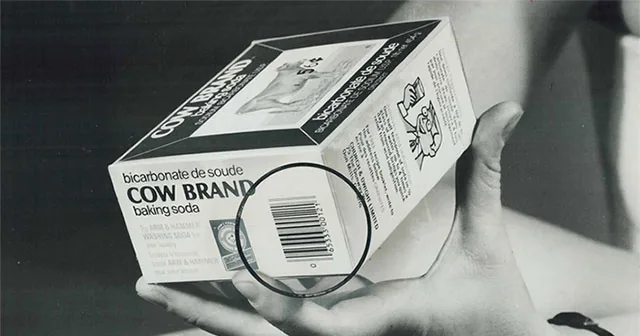
A cashier passes a small packet over a glass window. A beep replaces several strokes on a keyboard. Barcode history hides inside that ordinary sound, linking an idea drawn as a pattern with the databases, labels, and shared rules that made fast checkout practical on a very large scale.
The first idea did not look like today's familiar stripes
Norman Woodland and Bernard Silver worked on a code a machine could read from a label. Their early patent used a circular bull's-eye pattern, not today's familiar stripes. The aim was to let a scanner identify an item so a person did not have to type it in by hand.
The mark alone was not enough. Shops also needed cheap readers, sound printing, and records that gave each code a use. A clever drawing can sit on paper for years before the tools and shared rules around it make it useful on a busy shop floor.
A scanner turns contrasting marks into data
An optical scanner reads light and dark areas under a code's rules. A common retail barcode holds an item number, while the shop gets the price from its records. The stripes do not need to change on every packet each time that shop puts the item on sale.
The code points to a record. That is why a shop can alter a price without sticking a fresh label on every box. A successful beep means the pattern was read, not that the scanner learned every fact about the goods by looking at a few black lines.
Related Stories

Shared standards made one label useful in many places
UPC gave shops and suppliers a shared way to identify products. A common rule meant one label could be read in many places, instead of each firm building a private system. The work needed agreement as well as new machines, because a lone scanner could not change a supply chain.
The first famous retail scan was a packet of chewing gum in 1974. The moment makes a good story, but years of work led to it. Standards, tests, and shop systems mattered too, even though they look less exciting than the instant a checkout made its first beep.
Error checks help catch mistakes without proving authenticity
A check digit tests whether a number fits a mathematical rule. It can catch some scan or typing errors, but it does not prove that an item is genuine or safe. A copied number can pass the same test, so arithmetic cannot replace other checks on the goods and seller.
A valid code is not a passport for every ingredient. The mark is useful for identity, but it cannot bear every claim a buyer may attach to a product once the scanner has read it.
The stripes changed work beyond the checkout line
Fast scanning let shops link sales with stock counts and orders. The gain came from the code and the records around it, not from stripes that could think. The system helped turn a small printed mark into useful data as goods moved toward a buyer.
Other codes now serve other tasks and can hold different kinds of data. The old stripes still show a useful lesson: a modest mark can have a huge effect when many people agree how to make it, read it, and use what it tells them.
Frequently Asked Questions
These questions distinguish the printed code from the data systems that use it. A barcode gives a machine-readable pattern under agreed rules. Its usefulness grows when that pattern connects to accurate records, but neither a successful scan nor a valid number proves every claim made about the object carrying it.
Is a product's price stored in every retail barcode?
Usually the code identifies the item and the store retrieves its price from a database. Some specialized labels encode price or weight. So the answer depends on the code and use.
Does a valid barcode prove a product is genuine?
No, a code can be copied or misused. It helps identify a record, but assessing authenticity may need other checks about the product, seller, packaging, and supply chain.
Why are shared standards important?
They let different businesses read and interpret the same kind of label. Without agreement, a pattern useful to one shop might be meaningless to another, even if both owned good scanners.