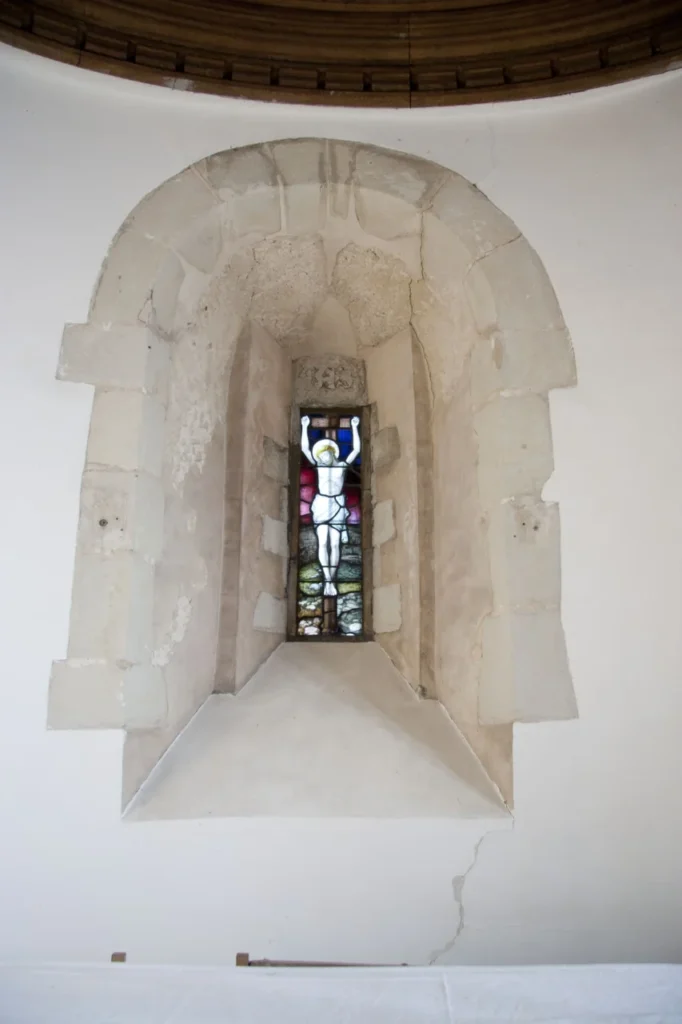
An old church window may be thicker at one edge, but centuries of slow dripping are not the reason. The well-known story turns an uneven pane into evidence of a flowing wall. Is glass a liquid?
At normal room temperature, the clear material holding back the weather is a solid.
Why the Window Story Sounds Convincing
Old window glass can change in thickness because of the methods used to make the sheets. Uneven panes are therefore not proof that gravity pulled the material downward over centuries. The Corning Museum of Glass explains that room-temperature glass does not flow in the way the well-known window myth suggests.
The myth starts with a real clue and adds the wrong past. You can see a thick edge. You cannot see the old workshop that made it.
If you do not know how the sheet was formed, it is easy to invent a slow change that the pane never went through.
A Solid Without a Crystal Pattern
An amorphous solid lacks the long-range repeating atomic arrangement found in a crystal. Glass can have that disordered atomic structure while still behaving as a solid. Disorder does not automatically mean liquid, just as the absence of neat rows does not tell you how easily the whole material will move.
Neat rows are not a test of flow. A floor of regular tiles and a floor of mixed stones may look different, yet both can stay firm. The picture is only a rough guide.
It helps show why a lack of crystal order does not by itself make something a liquid.
What Changes When Glass Gets Hot
Heating gives the structure more freedom to rearrange, and glass can soften enough to be formed. The glass transition concerns changes in how the material responds as temperature changes. It is not a reason to describe a window at room temperature as a puddle that moves slowly.
A glassblower works with heat far beyond that of a church wall. The same substance can act differently when hot. Time matters too.
A claim about glass in a furnace should not be moved into an ordinary room with the key facts about heat and scale left out of the tale.
Why the Distinction Matters
The liquid-glass myth mixes visible shape, microscopic arrangement, and response to heat into one simple label. A better explanation treats those features on their own. This helps explain other materials too.
A familiar look can hide a structure whose behavior depends on temperature, time, and how it was made.
You can enjoy the ripples in an old window without picturing it sliding down the frame. Those waves may be traces of skilled work. Their story lies in the way the glass was made, cooled, and fitted.
The true past can be just as rich as a slow-dripping myth.
Frequently Asked Questions
The key questions include room temperature, older manufacturing, and the meaning of an amorphous solid. Each points to a distinct part of the explanation. Once those parts are separated, a pane can be both microscopically disordered and firmly solid, with no need for the popular slow-dripping story at all.
Is window glass an amorphous solid?
Yes, normal window glass is described as an amorphous solid. It lacks long-range crystal order while retaining the physical behavior of a solid at room temperature.
Why are some old panes thicker at the bottom?
Old manufacturing methods made varying thicknesses, and fitting choices could place a thicker edge downward. The unevenness does not show that the glass flowed there over time.
Does glass ever become soft enough to shape?
Yes, heating can make glass workable. That hot behavior does not mean the same material flows like a liquid in a normal window.
Featured image: DavidKStockman / David Stockman · Source · by-sa/3.0. Resized proportionally and converted to WebP when downloaded. No crop.
