A jar of honey can turn grainy while still smelling like a summer field. That change often gets mistaken for decay. Why honey lasts so long has more to do with water and chemistry than with an endless shelf-life spell.
Even a famously durable food depends on the settings around it.
The Water Microbes Cannot Easily Use
Honey contains a great deal of sugar compared with its water content. That creates low water activity, meaning less water is available for many microbes to use. A food can contain some water while still making growth difficult, so total moisture and usable water are not exactly the same measure.
Water is part of a microbe’s setting, not just a number on a food label. The way it is held matters. A sweet, thick mix can deny many microbes the water they need to grow.
That helps explain why a jar lasts longer than a bowl of ripe, cut fruit.
Acidity Adds Another Barrier
Acidic honey gives another obstacle to many organisms. Bees also change nectar as they make and store honey, cutting moisture and adding enzymes. Several properties work together, which is why the explanation should not be cut to one ingredient or a claim that no organism can ever survive inside it.
Growth and survival are not the same. A food can slow the growth of many germs and still not be sterile. That is the gap in the phrase never goes bad.
It turns a useful fact about a well-kept jar into a promise that leaves out too much of the story.
Crystals Are a Change in Texture
Honey crystallization happens when sugars arrange into solid crystals within the mixture. It is a physical change and does not by itself prove spoilage. Distinct honeys crystallize at distinct rates because their sugar balance and storage settings differ.
So a smooth jar and a grainy jar can both be normal.
The pale grains can look odd if you expect clear gold. Yet one look cannot tell you the whole state of a food. Its source and how it was handled still matter.
A normal change in texture should not be used to prove that every part of a jar is safe.
Why Storage Still Changes the Story
Honey can take up water through moisture absorption, especially when exposed to damp air. More available water can allow fermentation under suitable settings. A closed container helps protect quality, while mixed products and contaminated jars need distinct consideration, so plain honey's durability should not be applied to every honey-based food.
There is a clear age limit. The CDC says not to give honey to a child under twelve months. Spores can pose a risk of infant botulism.
A long storage life does not remove that risk, and a fresh jar is not an exception to this rule for babies.
Frequently Asked Questions
Questions about honey often confuse a long-lasting food with a sterile or universally safe one. Crystals, microbial growth, and infant safety are distinct issues. Understanding each one gives a more useful answer than repeating an unlimited shelf-life claim without explaining the settings that make the food unusually durable.
Does crystallized honey mean it has spoiled?
No, crystals alone are a normal sugar change. They do not show the condition of the whole jar, so handling and other signs still matter.
Can honey ever ferment?
Yes, enough moisture can allow yeasts to ferment it. The often-repeated claim that honey can never spoil leaves out the importance of water and storage settings.
Can babies eat honey if it is fresh?
No, the CDC advises against honey before twelve months of age. Freshness does not remove the infant botulism concern.
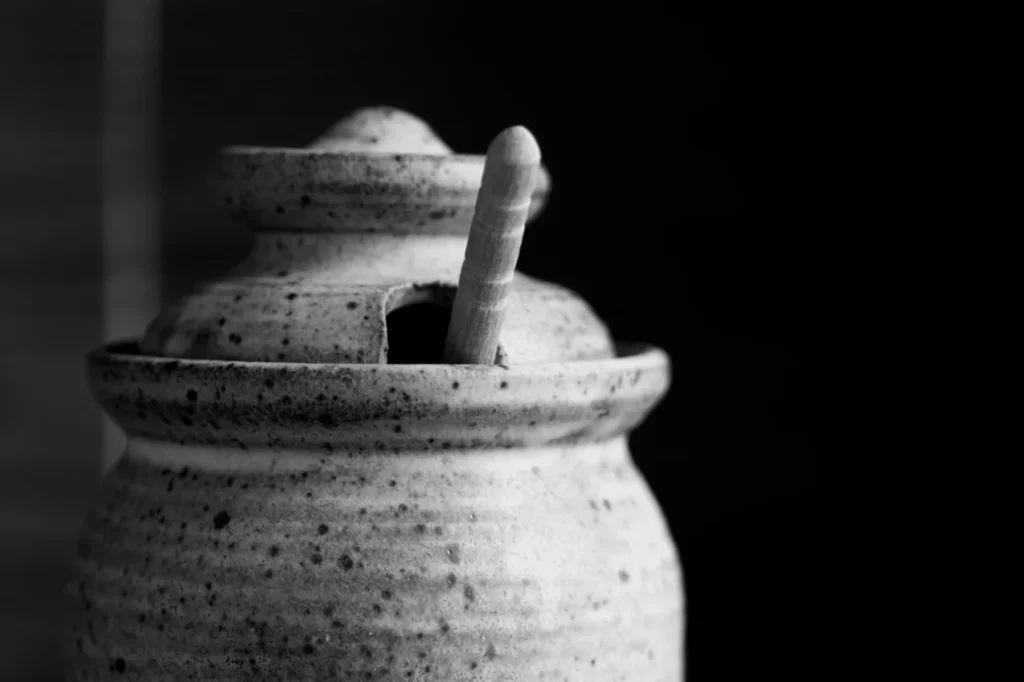
Featured image: Nic McPhee · Source · by-sa/2.0. Resized proportionally and converted to WebP when downloaded. No crop.
