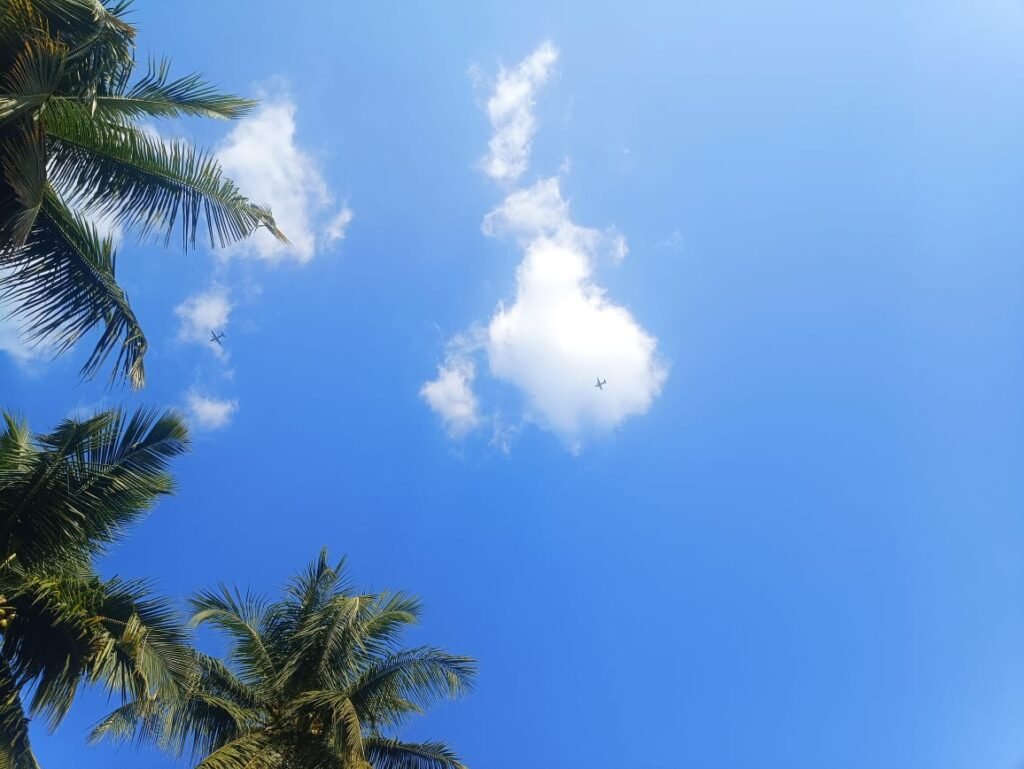
The blue above your roof is made from light that changed direction. It did not begin as a blue ceiling. And the ocean did not paint it there.
Why is the sky blue? The answer starts with white sunlight, tiny gas molecules, and the colors that get scattered on the way.
White Light Holds More Than One Color
The sunlight spectrum contains a range of visible colors, even when the light looks white. Those colors have distinct wavelengths. As sunlight passes through the atmosphere, air molecules redirect part of it, sending light toward an observer from directions that do not point straight back at the Sun itself.
A rainbow makes those hidden colors easy to see. But they are there on a plain day too. Look away from the Sun, and the blue light in your view has taken a new route.
Air sent some short wavelengths toward you instead of letting them travel straight from the bright disk.
Why the Shorter Waves Scatter More
Rayleigh scattering describes how very small particles, such as gas molecules, scatter shorter visible wavelengths more strongly than longer ones. Blue belongs to the shorter wavelengths. So a clear atmosphere sends plenty of blue light across the sky.
The process is scattering, not a blue pigment floating above the ground.
The gas need not be blue. It changes the path of some colors more than others. A vast number of such events fills your view.
A rule about light and tiny bits of matter thus becomes the wide blue dome above a roof, a road, or a field of dry grass.
Why We Do Not See a Violet Sky
Violet light has an even shorter wavelength than blue, but scattering strength alone does not determine the color we see. The sunlight reaching the atmosphere and the sensitivity of human vision also matter. Together, these factors make the well-known daytime sky appear blue to our eyes rather than simply violet.
Your eyes are part of the answer. They do not respond to every color with equal strength. The brain blends their signals into what you see.
A machine can measure the light in fine detail, but that record and your sense of blue describe two linked sides of the same view.
How the Same Process Makes a Red Sunset
At sunset, sunlight takes a longer path through the atmosphere before reaching your eyes. Much of the shorter-wavelength light has been scattered out of the direct beam. Longer wavelengths become more prominent, helping create red sunsets, while clouds, dust, and other particles can change the final colors you notice.
The blue overhead and the warm horizon belong to the same trip. In one case, light is sent toward you from the air. In the other, a long path has changed the mix that comes straight toward your eyes.
The sky can show both effects as the Sun sinks low.
Frequently Asked Questions
These questions distinct the source of the color from nearby things that also look blue. The explanation works over land and sea because air and sunlight supply the main ingredients. Changes in viewing direction and atmospheric thickness help explain why one part of the sky can look distinct from another.
Is the sky blue because it reflects the ocean?
No, the main cause is scattering by the atmosphere. The sky can be blue above deserts and inland places far from any sea.
Why does the sky look pale near the horizon?
Light reaches you through more atmosphere in that direction. Repeated scattering and larger particles can mix the colors and cut the strong blue look.
Would the sky be blue without an atmosphere?
No, without air there would be little scattered sunlight filling the sky. The Sun would still shine. But the nearby daytime sky would appear dark.
Featured image: Renukarenu1861 · Source · cc0. Resized proportionally and converted to WebP when downloaded. No crop.
