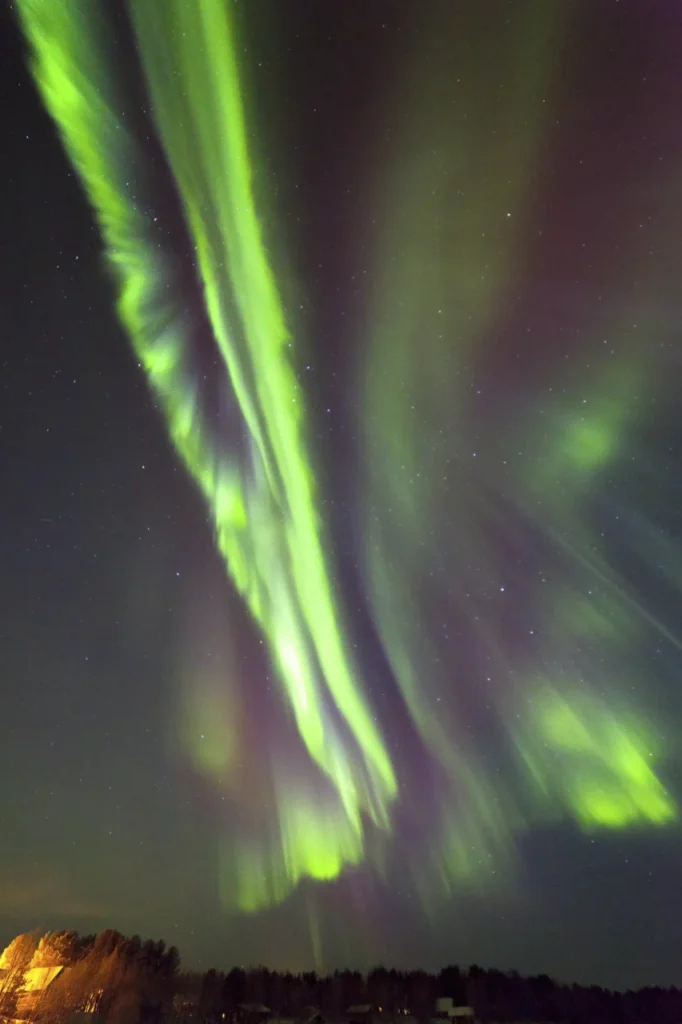
A green curtain seems where the night should be empty. It stretches, fades, and returns with a red edge. Nothing is burning above the horizon.
What causes northern lights colors is a meeting between energetic particles and thin air, far above the quiet ground where people watch.
The Atmosphere Receives a Visitor
The aurora borealis forms when energetic charged particles interact with gases in the upper atmosphere. Earth’s magnetic field helps guide particles toward high-latitude regions. Collisions transfer energy to atoms and molecules, which can later release some of that energy as light that we see from the ground below.
The glow is not just a cloud lit by the Sun. The gas gives off its own light after it gains energy. That is why the ribbons can shine in a dark sky.
An ordinary cloud would need light from somewhere else to show up in the same way at night.
Why Green and Red Can Share the Sky
Oxygen atoms can make well-known green auroral light and also red light under distinct settings. The color depends on the energy change involved and the height where it happens. Thin air at higher altitudes allows some slower light-emitting processes to occur before another collision interrupts them and changes the result.
Think of an atom given extra energy. When it lets some go as light, the size of that change helps set the color. One tiny event is faint.
Vast numbers of them can form the green bands and red tops that people see from the cold ground far below.
Where Pink, Purple, and Blue Come From
Nitrogen molecules and their charged forms contribute extra colors, such as blue and pink or purple tones. Actual displays mix light from distinct gases and heights. Cameras can record faint colors more strongly than eyes.
So a photograph may show a richer palette than a person noticed during that display.
A bright photo need not be fake. A camera can keep gathering light while your eyes take a much shorter view. Its settings shape the result.
To judge an image, ask how it was made and what the caption says, rather than expect it to match each person’s glance.
A Moving Display of Space Weather
Auroral shapes change as the flow of particles and the nearby magnetic settings change. Solar activity can disturb the near-Earth setting and expand the region where auroras appear. A forecast describes a chance, while cloud cover, darkness, local light, and the event itself still determine what a viewer can see.
A ribbon of light links the ground to events far out in space. You cannot see the whole chain at once. But its final step is there above the trees: gas gives back part of the energy it gained.
The colors turn an unseen process into something we can watch.
Frequently Asked Questions
The most common color questions have answers in atmospheric gases, light collection, and magnetic geography. A green photograph alone cannot identify every process in a display. It helps to know what emitted the light, how high it occurred, and how the observer or camera collected that faint signal.
Does oxygen make only green auroras?
No, oxygen can also make red auroral light. The emission depends on the energy transition and settings, such as altitude and the chance of further collisions.
Why do aurora photos look brighter than the real sky?
Cameras can collect light over longer exposures than a single human glance. Sensors and processing also affect how strongly faint colors appear.
Are the northern lights always over the North Pole?
No, they usually occur across a changing oval around the magnetic polar region. Strong activity can expand that zone and make displays visible farther south.
Featured image: Martincco · Source · by-sa/4.0. Resized proportionally and converted to WebP when downloaded. No crop.
