Two beams of light take long paths across the ground, then meet again. A tiny change in how they join may carry news from a pair of black holes far away. How LIGO detects waves begins with that quiet comparison, where a small shift must be found among much larger movements close to home.
A wave can change the distance between things
Gravitational waves are ripples in spacetime that can come from moving masses, such as two black holes spiraling together. They can stretch and squeeze relative distances as they pass. By the time a wave reaches Earth, the effect can be so small that no person could see it happen.
The wave is not a sound that has crossed space through air. It can travel through a vacuum. The chirp played in news reports is a way to let us hear a changing signal.
It is not a microphone picking up the roar of a collision from another galaxy.
Light makes two long paths worth comparing
A laser interferometer splits light along two arms and brings the beams back together. A change in their relative paths changes how the waves of light combine. Mirrors and optical cavities help make the system sensitive to very small effects, rather than relying on someone reading marks on a ruler.
Picture two waves meeting. Their peaks can line up or fall out of step. What matters is a change between the arms, recorded in a form that teams can measure and check against known tests.
Related Stories

The mirrors must be shielded from local motion
Mirror motion can come from the ground, heat, nearby machinery, and many other sources. LIGO uses vacuum systems, isolation, and controls to reduce unwanted effects. Sensors also record the local environment, since a detector that notices a small change still needs a way to test what caused that change.
A truck or a passing storm is much closer than the source in space. The machine must be sensitive without treating every disturbance as a discovery, which is why the quiet engineering matters as much as the final plot.
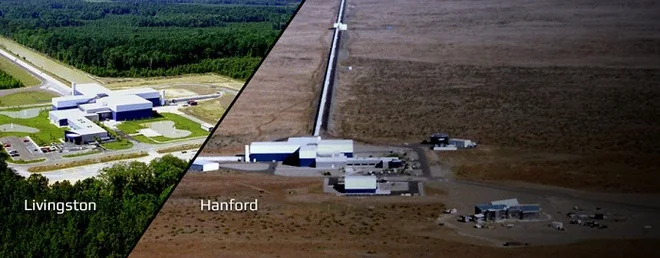
A second site helps test a brief signal
Separated detectors can compare one candidate event. A real wave should reach them at times and strengths that fit their layout and the wave's direction. A local fault at one site need not appear at another, so agreement across a network gives teams a stronger test than one trace alone.
That does not make every shared pattern real. Data quality, timing, and noise still need checks. But the network provides new questions to ask.
Can one source explain what each site saw? Does the small gap in arrival times fit a wave crossing Earth at the speed of light?
A changing rhythm carries clues about its source
Signal matching compares the record with predicted waveforms. For a merging pair, the pattern can reveal clues about masses, motion, and the final object. Several features can affect the same trace, so the result includes uncertainty rather than pretending the detector made a direct photograph of the distant event.
The models must fit more than one appealing feature. Where other telescopes also detect light, those records can add a different view. Each tool helps test the picture, instead of one dramatic sound clip settling every detail by itself.
Frequently Asked Questions
Spacetime strain, the optical record, and an audible chirp are related but distinct parts of the story. The detector measures an effect here on Earth. Teams then use models and checks to infer a distant cause, while reporting what the data can and cannot tell them about that cause.
Does LIGO hear sound from black holes?
Not in the everyday sense. Its main measurement concerns relative changes in light paths, and an audible version presents the signal in another form. Ordinary sound does not cross a vacuum from the source.
Why are the arms so long?
The length helps set the size of the distance change caused by a given strain. Long arms alone are not enough; the mirrors, optics, controls, and noise levels also affect what can be measured.
Does every odd trace count as a discovery?
No, Teams check local noise, instrument behavior, timing, and agreement across sites. A useful claim needs that evidence, not just a trace that looks striking on a screen for a brief moment.