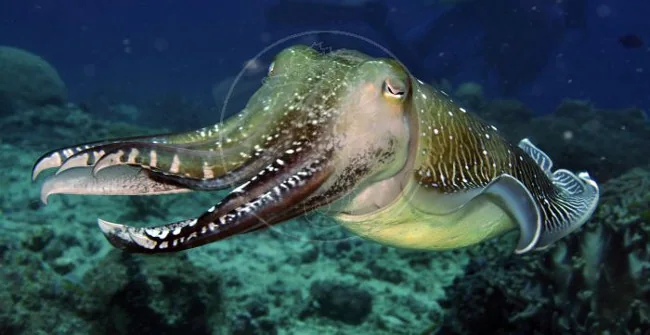
A cuttlefish crosses pale sand, then settles beside a dark rock. Its outline and skin seem to join the new scene almost at once. Cuttlefish camouflage is not one coat of color laid over another.
It is a layered display of pigment, reflected light, texture, and rapid control across the animal's body.
Pigment patches can change their visible size
Chromatophores hold pigment and are controlled by small muscles. Expanding or shrinking them changes how much color we see in a patch of skin. Many units work together, so the cuttlefish can change a broad pattern quickly without moving fresh color all the way from head to tail.
The animal does not have to push fresh color all the way from head to tail. Nerve signals control many spots at once, turning small local changes into a broad pattern that can shift while the cuttlefish stays almost still.
Reflected light adds another layer to the display
Reflective cells add effects that pigment alone cannot make. These layers alter how light comes back from the skin, changing its brightness and color. The result depends on the light and the view as well as the animal, not just on a fixed store of colored material beneath its surface.
A reflecting layer can look different as the angle or the light changes. This is not just paint hidden under a clear cover. Several layers work together, and the view you see depends on the scene as well as on the animal's own skin.
Related Stories


Skin texture can help break the outline
Skin papillae can make parts of the surface rougher or smoother. With visual patterns, this can help break up the outline among rocks or other complex ground. The exact display depends on species and setting, so not every cuttlefish uses all textures in the same way or at once.
A flat shade may match a rock's color but still leave a smooth body easy to spot. Bumps and shadows can help disguise the outline too. The trick is to make the body's edges harder to separate from the ground, not just to choose a similar shade.
Vision helps select patterns without requiring a perfect copy
Background matching uses clues such as contrast, size, and layout. A cuttlefish need not copy each stone like a camera to become hard to spot. Its pattern can instead hide the cues a hunter would use to split the body's shape from the ground in the view that matters.
A close photo on a bright screen is not the predator's view. The animal may be seen from farther away, in dimmer light, or at a different angle. A pattern can help hide it without copying every grain of sand.
The useful test is whether the hunter can spot it there.
Camouflage is only one use of changing skin
Changing skin can also serve courtship, warning, or other signals. A bright shift is not always an attempt to hide. The rest of the scene matters, including nearby animals and what happened before the change, so a dazzling close-up alone cannot tell us the purpose of every display.
A strong display toward another animal may be a signal, not an effort to vanish. The same skin can help with hiding, courtship, or conflict. A short clip of changing color is only a piece of that behavior, not its whole explanation.
Frequently Asked Questions
Pigment, reflected light, texture, and motion all shape the view of a cuttlefish. These questions separate those parts and place them back in the scene. A useful reading asks what else is present, rather than assuming that every change in skin is an attempt to vanish from sight.
Does a cuttlefish change color by moving paint through its body?
No, Pigment structures change their visible area, while other skin layers influence reflected light. The rapid display relies on controlled structures already present in the skin rather than new paint being transported across it.
Does every color change mean it is hiding?
No, Displays can also relate to communication, courtship, threat, or prey interactions. The surrounding behavior is needed to interpret a shift rather than assuming every bright pattern serves the same purpose.
Does the animal copy the background exactly?
Not like a camera. It responds to visual features and can reduce cues that reveal its outline. A useful disguise need not reproduce every small detail in the scene pixel for pixel.