

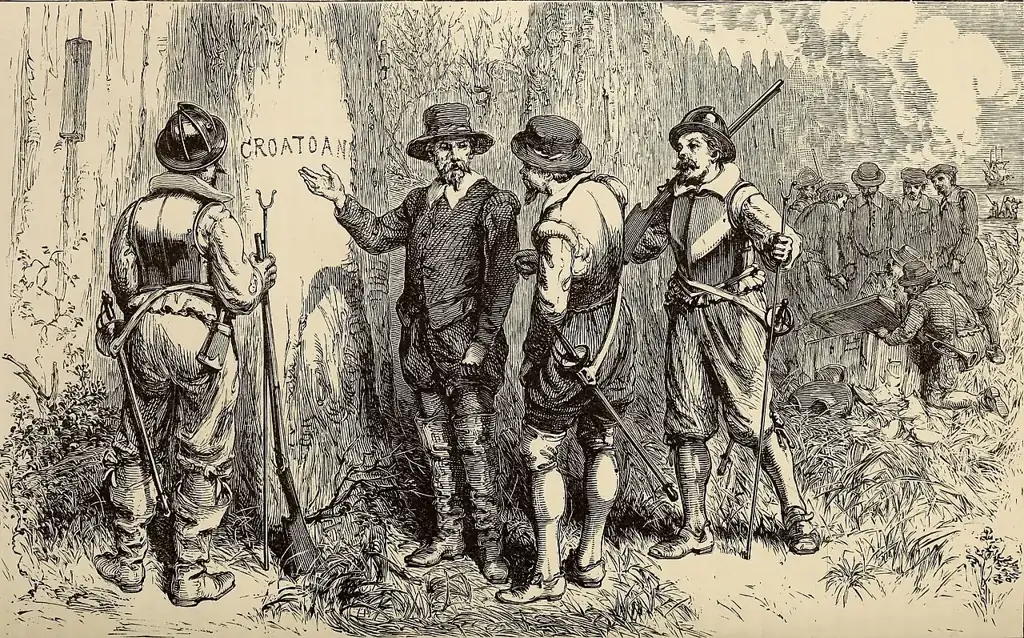
The empty settlement had left a word behind. In 1590, John White reached Roanoke and found “CROATOAN” cut into a wooden post.
For modern readers, it can sound like a threat. For White, it pointed toward a people and a place he knew.
That small difference shifts the Roanoke colony mystery. The story is not simply about people who vanished.
It is about a delayed rescue, a planned message, and lives the record fails to follow.
Three years changed the search
White left the English settlement in 1587 to seek supplies and returned in 1590. War, shipping problems, and other delays stretched the gap. When he reached the abandoned site, the colonists were gone, but a carved place name offered a possible direction for the search.
The John White return came after far too much time for a simple answer. Shelters, food supplies, and local ties could all shift while he was away.
The absence of people did not show when they left or whether everyone traveled together. A quiet site can preserve the end of a process while hiding most of its steps.
Croatoan was not a mysterious code
The Croatoan carving referred to a Native community and an island now called Hatteras Island. White understood the name and believed the colonists might have moved there. It was a useful clue within a well-known coastal world, rather than an unknown word with no local meaning.
Before leaving, White had arranged for a message if the settlement moved. The surviving inscription fits that plan better than many later tales suggest.
A storm blocked his attempt to investigate Croatoan. Here the story takes its harshest turn: a clue existed.
But the search could not follow it. A missing answer slowly became a legend of sudden loss.
Related Stories
Native history belongs at the center
Carolina Algonquian communities were not a backdrop to the colony. They had their own homes, knowledge, alliances, and conflicts long before the English arrived. Any account of survival must consider those ties, including the damage caused by English violence and mistaken attacks on possible allies.
One idea is that some colonists joined nearby Native groups. Another is that groups moved in distinct directions.
Neither idea needs every person to share one fate.
This perspective also shifts whose questions matter. Instead of asking only where the English went, ask which groups received newcomers, which contacts were possible, and what kinds of clues could preserve those encounters.
A found object is not a solved case
Lost Colony evidence includes written accounts, landscapes, and dug-up objects, but each has limits. An English artifact found at a Native site may reflect trade rather than a colonist living there. Strong claims need a clear context, sound dating, and several clues pointing toward the same answer.
An object can travel farther than its first owner. A fragment of pottery does not carry a full address or tell us why it changed hands.
That is why the mystery stays open despite real research. The most careful account can offer plausible routes without naming a final home for every missing person.
Resisting a tidy ending keeps the people in the story human.
The carved word is a place to begin a search. It is not a list of names or a record of what happened next.
That gap deserves close study, not a tale that fills every silence with fear.
Frequently Asked Questions
Roanoke is unresolved, but it is not empty of clues. Dates, written views, a carved name, and Native history limit the options. The challenge is connecting those pieces to given people without turning a reasonable theory into a full account that the surviving record cannot yet support.
What did CROATOAN mean at Roanoke?
It named a Native people and their island, now Hatteras Island. White read it as a possible move message, not as proof of a magic event.
Did the colonists all disappear at once?
The clues do not show a single moment or one shared fate. People may have moved in groups, and the long gap before White returned makes the sequence hard to reconstruct.
Has archaeology fully solved Roanoke?
No single discovery has shown the fate of every colonist. Finds can support contact or possible movement.
But trade and unclear context complicate a final match.



.jpg)