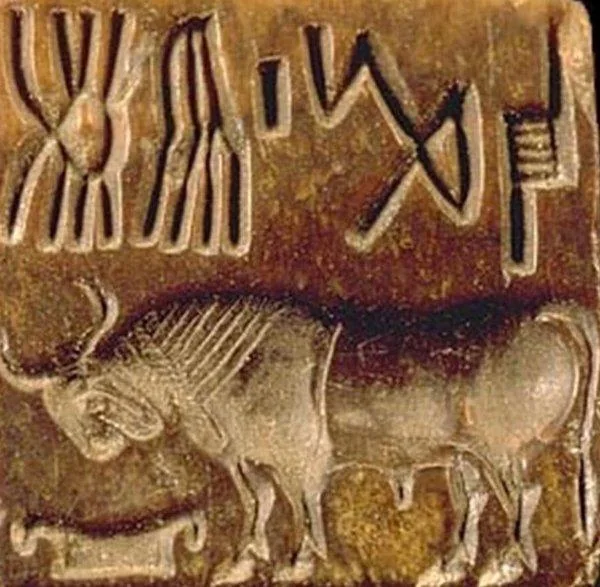
A tiny carved animal stands beneath a row of signs, as sharp as a message left yesterday. The seal survived for thousands of years. Its words, if they are words, have not made the same journey into our understanding.
The Indus script mystery begins with this strange gap between seeing a mark and being able to read it.
A great urban culture left very small texts
Harappan seals and other objects carry short groups of signs associated with the Indus civilization. Many come from the urban world that flourished during the third millennium BCE. These marks preserve patterns, yet their brevity gives researchers far less material than the long inscriptions available for some other ancient societies.
Those possibilities are useful questions, not established translations. Finding a seal in a trading setting does not tell us exactly what each sign meant or how anyone pronounced it.
Short inscriptions make every guess harder
Short inscriptions limit the clues a reader can test. A long text may repeat names, titles, verbs, or numbers in ways that expose its structure. A few signs offer fewer such checks, and many proposed readings can appear to fit when the sample is small and its purpose remains uncertain.
Imagine trying to recover a lost language from luggage labels. You might spot repeated shapes without knowing whether they name owners, places, amounts, or classes of goods.
That is only an analogy, but it captures the difficulty. A plausible match needs to explain a broad body of evidence, not one attractive object selected after the idea was formed.
Related Stories

Order can reveal structure without giving meaning
Researchers use sign patterns to study which marks appear together and where they occur in a sequence. Statistical work can reveal regularities that random arrangements would not easily produce. Such structure is important evidence, but it does not reveal a language, a sound value, or the meaning of a sentence.
A machine finding a likely next sign has not necessarily translated anything. Prediction concerns pattern. Translation needs a defensible link between that pattern and meaning, supported by independent checks.
The missing bridge is more than a dictionary
A bilingual text, written in the unknown system and a readable one, could offer a powerful bridge. No accepted equivalent of the Rosetta Stone has resolved this problem. Researchers debate the language behind the signs and the extent to which the system encoded speech rather than other kinds of information.
An animal picture beside signs does not supply a ready dictionary. The picture might relate to a clan, a belief, an office, or something we have not considered.
The safest reading of the evidence keeps several possibilities open. It also separates a proposed decipherment from one that other specialists can reproduce and successfully test on new material.
Silence does not erase the people behind the seals
Archaeology reveals much about Indus life even while ancient writing remains unread. Streets, drains, craft workshops, weights, and traded objects provide other routes into the past. The unread signs mark a limit in our knowledge, but they do not turn a complex urban society into an empty or unknowable place.
That balance makes the seals more compelling. They are neither proof of a secret lost technology nor meaningless decoration by default. They are evidence awaiting a stronger bridge between pattern and understanding.
Frequently Asked Questions
Readers often ask whether a computer has solved the script or whether one new symbol could unlock it. The strongest answer is to distinguish useful progress from a complete decipherment. Cataloging, excavation, statistics, and fresh finds can improve the evidence without producing a translation accepted across the research field.
Has AI translated the Indus script?
No broadly accepted decipherment has emerged from AI claims. A convincing result must explain many inscriptions and survive independent testing, rather than offer fluent guesses.
Why not use a modern Indian language?
A modern language may inform a hypothesis, but the ancient language is uncertain. Choosing it first can encourage a researcher to force signs into a preferred reading.
Would one long inscription solve the mystery?
It could help greatly, especially with a clear context. A long text alone would still need careful study and a way to test proposed meanings.