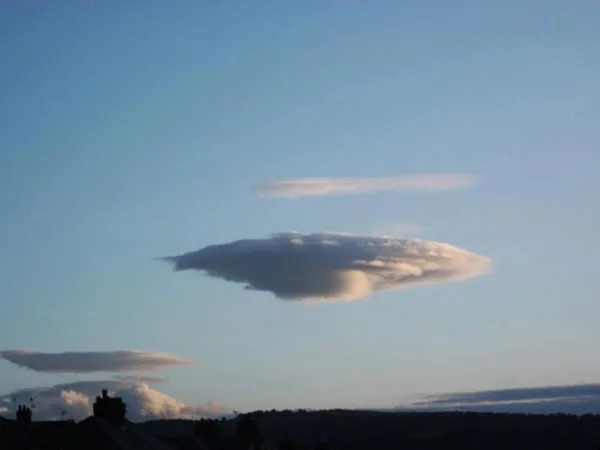
The smooth disk hangs over a mountain while the wind keeps moving. Its edges stay clean, and another pale layer may seem stacked above it. Seen at dusk, it is an easy shape to mistake for a flying saucer.
Lenticular clouds explained through weather reveal something just as striking: moving air can build a cloud that appears to stand still.
A mountain can send a wave through the air
Stable moist air flowing over a mountain can develop waves. Rising parts cool, allowing vapor to condense where conditions permit. A smooth lens-shaped cloud may form near a wave crest, making invisible air motion visible without requiring a storm to grow in the same place.
A mountain is a common trigger, not a universal requirement. Other disturbances can create suitable waves. The cloud's shape offers a clue about air movement, but the setting still needs to be examined.
A still outline can contain constantly changing droplets
A standing wave can stay in roughly the same position while air passes through it. Droplets form where the rising air becomes cool and moist enough, then evaporate as the air descends. The visible cloud may therefore hold its outline even though the water making that outline keeps changing.
That distinction explains the eerie stillness. The wind has not stopped. It is part of the reason the cloud can remain in place at all.
Related Stories
Several moist layers can build a stack
Condensation can occur at more than one height when the atmosphere contains suitable moist layers. Each layer may trace part of the wave, producing stacked lenses with clear gaps between them. Their smooth surfaces and repeated curves can look unusually engineered.
Light changes the effect. A low Sun can warm an edge while leaving the underside gray, making the disk seem more solid than a cloud seen at noon.
The resemblance helps explain some UFO reports
A disk-shaped cloud can explain some UFO reports near suitable terrain. It cannot explain every sighting by shape alone. A sound identification must also fit the location, time, movement, weather, and other available records, rather than turning a plausible resemblance into a guaranteed answer.
An unidentified observation is a starting point for investigation. It does not establish an extraterrestrial craft, and a confident guess is not a substitute for checking the scene.
Useful details include a sequence of images, landmarks, weather records, and the duration of the sighting. Those clues can distinguish a persistent cloud pattern from many competing possibilities.
A beautiful cloud can mark unsettled air for pilots
Stable air describes the atmosphere's resistance to vertical displacement, not a guarantee of smooth flying everywhere nearby. Mountain waves can accompany strong vertical motions and turbulence in associated areas. Pilots use forecasts and operational guidance to assess these conditions, rather than judging flight conditions from a cloud's peaceful appearance alone.
For a person watching safely from the ground, the simplest response is to notice the relationship between cloud and mountain. Does the lens stay near the same ridge as other clouds drift past?
That comparison reveals the hidden motion. The apparent saucer becomes a sign drawn by the atmosphere, showing where an invisible wave has found enough moisture to become visible.
The cloud's edge marks where droplets can persist. Beyond that boundary, the same air may look clear because its water is vapor rather than visible drops.
Frequently Asked Questions
The shape raises questions about movement, rarity, and identification. The key is to distinguish the flow of air from the position of the visible pattern. These answers describe the common mountain-wave setting, while recognizing that cloud formation depends on the wider atmosphere rather than a mountain acting by itself.
Are lenticular clouds solid objects?
No. They consist of cloud droplets or ice particles, depending on conditions. Their smooth boundary can make them look more solid than they are.
Why do they seem motionless in strong wind?
Air can flow through a wave that remains near the same place. Droplets form and vanish as the air moves, preserving the overall outline.
Do they prove a storm is coming?
No single cloud type guarantees a local storm. Lenticular clouds indicate particular wave and moisture conditions, and a full forecast needs much more information.