

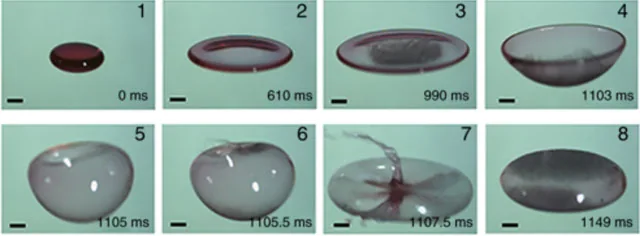
A drop hangs in air with no cup beneath it. Sound holds it up. Acoustic levitation uses a shaped field to support small samples without a solid stand.
The drop still has weight, and the air is not frozen. A balance of forces makes this quiet, strange-looking scene possible.
Sound carries a changing pressure pattern
Acoustic pressure comes from sound waves moving through a medium. In a suitable field, sound can exert a net force on a small object. That is a real push, not a way to turn off gravity or remove mass, so the object still needs support while it floats.
For the object to stay put, the forces must balance in a stable way. The sound is doing work in the setup; the sample has not lost its weight.
Opposing waves can create places to trap an object
Standing waves form stable patterns when sound waves combine in a suitable setup. Those patterns can make trapping regions for certain objects. The forces hold a sample near a chosen point, and a controlled change to the field may move it, without a solid shelf beneath it.
Standing does not mean the air has become still or hard. Pressure keeps changing fast, while the broad pattern stays in place. The object responds to the net force over that rapid cycle, so it can remain held at one point without a rigid stand touching its underside.
Related Stories



Small objects are easier than the giant scenes in fiction
Small droplets and light particles are easier targets than large, heavy objects. Size, shape, density, and wavelength all affect force and stability. Holding a tiny drop does not show the same machine can lift a person; scaling up creates new limits, not merely a need to raise the volume.
A bead, drop, and rough grain need not act alike. Before a method becomes a practical tool, the work has to show what range it can handle, not just the one sample that made the neatest clip.
The hardware shapes the useful field
Ultrasonic transducers make sound above the normal range of human hearing. Reflectors or arrays of emitters shape the field, with timing and spacing under control. A loud song from a home speaker does not alone create the stable trap seen in a designed experiment, because volume is not enough.
Several emitters can work together to shift the field. The empty-looking space above the device is therefore a planned working region with bounds, rather than a random patch of air in which sound has made weight cease to matter.
Avoiding walls can help a measurement without removing every influence
Contact-free handling can avoid some effects from a container wall. The sample still meets air, sound, heat, and gravity, so it is not completely undisturbed. Teams must check whether the method improves a measurement and account for new effects from the field that holds the sample away from the wall.
A drop may evaporate, warm up, stretch, or move while it is held. Those are not always reasons to reject the method, but they belong in the analysis. The useful choice removes one unwanted contact while making the remaining effects clear enough to measure, rather than hide, in the result.
Frequently Asked Questions
Sound supports the sample; it does not remove the sample's weight. These questions explain that balance and scale limits. A tiny drop in a designed field is useful evidence, but it cannot show a normal speaker could lift a person or that a floating sample feels no other forces.
Is acoustic levitation the same as zero gravity?
No, Gravity still acts while the sound supplies a balancing force. The sample has not lost its mass or weight, even though no solid stand touches it and it appears to hang in open air.
Can a normal home speaker levitate a person?
No, the size, power, field control, and safety issues differ greatly from a tiny-drop test. A home speaker playing loudly is not the same device as a designed acoustic trap in a lab.
Why keep a drop away from a container?
A wall can affect or contaminate a sample. Removing that contact can help, but sound and air still act on the drop, so their effects must be measured rather than assumed to have disappeared.





