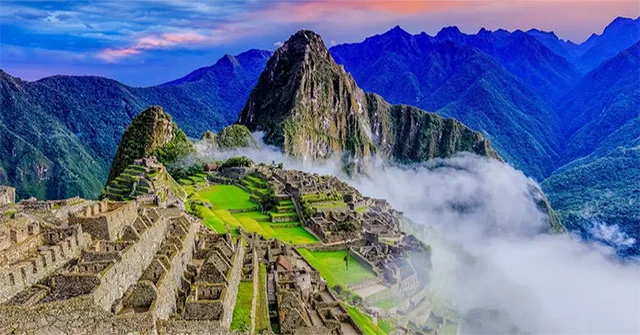
The stone walls catch the eye, but much of Machu Picchu's survival story lies underfoot. A mountain settlement cannot ignore rain pouring down a steep slope. Machu Picchu drainage shows how terraces, buried layers, and carefully directed water helped make a remarkable place usable, long before it became a view on a postcard.
Rain was a design problem from the beginning
Machu Picchu's builders had to manage heavy rain on steep ground. Terraces, drains, channels, and buried layers worked with the visible walls. The stonework depended on that wider system, because a fine building still needs stable ground and a safe route for water to leave.
The setting was not a blank platform. Its slopes, rock, soil, and rainfall shaped what could be built and how it had to function.
A wall may look like the main achievement, yet it relies on ground that stays stable. Managing water helps protect that ground and the people using the spaces above it.
Terraces changed the path down the slope
Terraces form steps across a slope. Walls hold soil, while internal layers and outlets help manage water. Their roles can include cultivation and structural support, but each area needs its own context; the same stepped appearance does not prove that every terrace served the same task.
The tidy surface hides a three-dimensional system. What lies behind the stone face can matter as much as the pattern of the blocks visible from a path.
Related Stories

Drinking water and runoff needed different routes
Supply channels and drains did different jobs. One route could bring usable water, while another carried runoff away. A channel's slope, position, and connections help identify its role, so the presence of fountains does not mean every carved water route supplied people with drinking water.
The course of a channel, its slope, and its connection to other features help reveal its role. Archaeological interpretation follows those relationships.
That practical reading is more useful than treating each carefully cut line as a mysterious symbol. Some of the most impressive engineering solved everyday needs with a clear route for water to follow.
Fine masonry was part of a larger system
Fine granite masonry shows skilled work, but wall fit alone cannot explain the site. Foundations, terrain, drainage, and upkeep also matter. Calling the construction impossible erases the builders' tools, planning, labor, and knowledge rather than helping readers understand how the buildings worked in their mountain setting.
Explaining that skill does not reduce the wonder. It restores the builders to their achievement instead of replacing their effort with an unsupported story about unknown outside help.
The hidden work deserves a place in the view
Rain connects slopes, terraces, walls, and drains into one landscape. Looking at those links explains more than admiring stone faces alone. The site's survival does not prove that everything stayed untouched, but it makes water management central to any fair account of the builders' engineering skill.
The famous panorama can make the settlement look still. Rain reveals that it is part of a moving system, with water seeking a route through every surface.
The site also had to provide routes for people to move between levels. Stairs, paths, open areas, and building entrances shaped daily use alongside drains. A working plan had to fit these needs together.
Inca engineering linked stone terraces and water channels to the demands of mountain rainfall.
Frequently Asked Questions
The main questions concern terraces, water supply, and the site's survival. These answers keep stonework connected with what lies beneath it. They avoid treating a long-lived ruin as proof of one perfect technique, since construction, local geology, weather, and later care all influence what remains for people to study today.
Were all the terraces used to grow food?
No single purpose should be assigned to every terrace. Some areas also served important structural and landscape-management roles, depending on their position and construction.
Did the Inca build drainage below the surface?
Yes, subsurface construction forms an important part of the site's water management. A photograph of the stone faces alone does not show the whole system.
Did an outsider discover an entirely unknown city in 1911?
That wording erases local knowledge. Hiram Bingham brought the site wide international attention, but local people already knew of its existence.