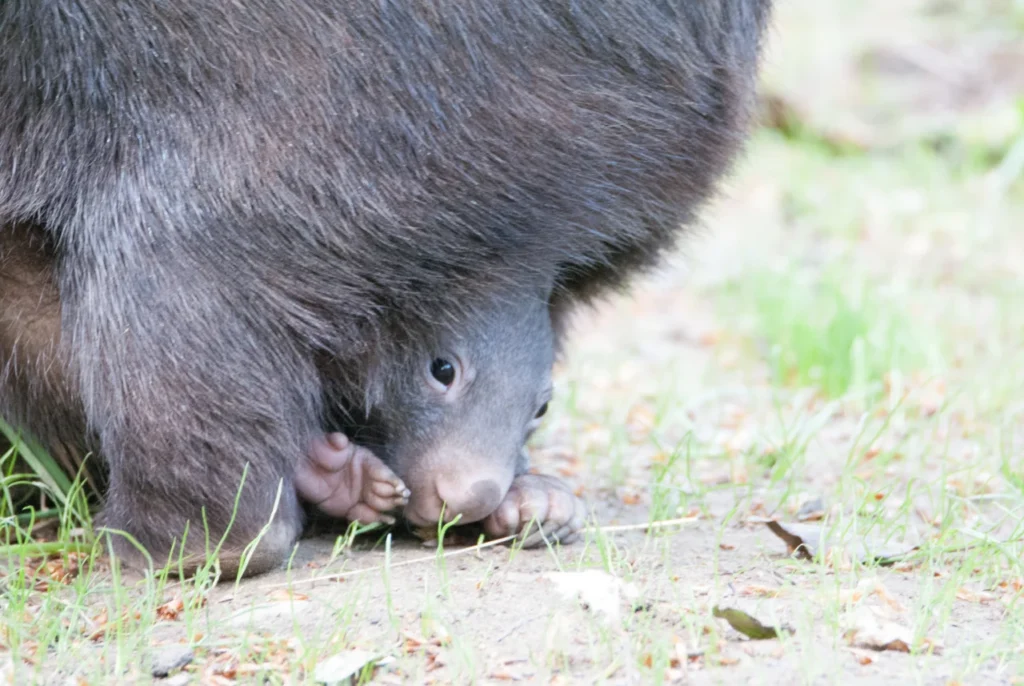
A soft-bodied animal leaves a little block on the ground. The edges look more like something cut in a workshop than something made inside a mammal. Why wombats poop cubes sounds like a joke until you try to explain how a flexible tube could shape those corners without a square mold.
The Shape Starts Before the Exit
The common wombat shapes its droppings inside the gut, not with a square exit. Cube-shaped droppings take form before they leave the body. That shifts the puzzle away from an odd opening.
The key lies in the walls of the tube and the forces they apply to what passes through.
The last step we see is not always where a shape began. The material has already passed through a long gut. It has lost water and grown firm along the way.
So the exit alone cannot tell us how a round tube made a block with flat sides and clear edges.
A Tube With Unequal Walls
Tests found that intestinal stiffness changes around the gut wall. Stiff and soft zones move in distinct ways as the tube contracts. Models show how this can help shape corners and flat sides.
No hard box is needed, but the wall must vary in how it bends around the tube.
Think of a ring with some stiff parts and some soft parts. Squeeze it, and each part will move in its own way. It need not stay round.
The real gut is more complex, but the ring helps show how soft walls can shape corners without a hard, square mold.
Drying and Contractions Work Together
The gut takes water out as its contents move along. That makes the mix firmer while the walls squeeze it. The shape comes from several steps, not one odd part.
A still view of the digestive tract cannot by itself tell us how the final block came to form.
A living body makes things in stages. The mix grows firm while the walls keep moving. To explain the cube, a team must know when each step takes place.
The final shape is a record of the path and forces that acted on it, not just the last squeeze.
Why an Odd Question Can Be Useful
The cubes link soft-body physics with life in the wild. Teams test tissue and models to see how edges form. Scent marking may help explain the setting.
But how a shape forms and why it evolved are distinct questions, and each needs its own kind of proof or clues.
A block may roll less than a rounded pellet. That does not prove why the trait evolved. A useful guess about purpose needs its own tests.
The strong finding here concerns how the shape forms, a small puzzle that links the soft wall of a gut to the edges of a cube.
Frequently Asked Questions
A cube makes people think of a square hole or a hidden cutting tool. The tests point to a softer route. These answers explain where the shape starts and why a claim about its purpose needs more than a model that shows how the gut can make flat sides.
Do wombats have a square anus?
No, a square exit is not the explanation supported by the research. Shaping occurs within the intestine before the droppings leave the body.
Are the droppings cut into cubes by bones?
The research emphasizes intestinal mechanics rather than a bone-cutting process. Differences in wall stiffness and repeated contractions help explain the shape.
Does the cube shape prove a scent-marking purpose?
No, a possible benefit is not proof of an evolutionary cause. Scientists need ecological evidence as well as a working account of the physical mechanism.
Featured image: TimSagorski · Source · by-sa/4.0. Resized proportionally and converted to WebP when downloaded. No crop.
