

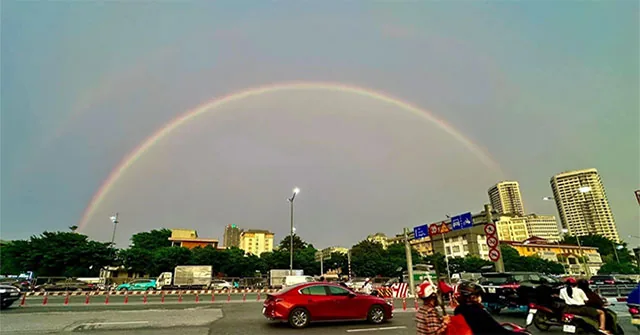
The second rainbow has its colors backward. Look closely after a sunlit shower, and the faint outer arc puts red where the inner bow does not. That reversal is not a trick of the camera.
Understanding how double rainbows form means following sunlight through one small drop of water and counting the turns it takes.
A drop changes the route of sunlight
A rainbow appears when sunlight enters raindrops, bends, reflects inside them, and leaves in a new direction. Different wavelengths bend by different amounts, spreading white light into colors. The observer sees light from many separate drops that happen to send the right colors toward the same pair of eyes.
This bending is refraction. The reflection takes place at the back of a drop, although some light also passes through rather than turning back.
A rainbow is therefore not a painted band hanging at one location. It is a viewing pattern, shaped by sunlight, water, and your position relative to both.
The outer bow takes an extra turn
A secondary rainbow forms from light that reflects twice inside a raindrop before escaping. That extra internal reflection changes the exit direction and reverses the color order. It reduces how much light that reaches the observer, which helps explain why the outer bow looks much fainter than the inner one.
In the main bow, red sits on the outside edge and violet toward the inside. In the secondary bow, the sequence runs the other way.
The word “double” describes two routes through drops. It does not require two Suns or two separate rainstorms, although more than one curtain of rain can complicate the view.
Related Stories

The dark gap is part of the pattern
Alexander's band is the darker sky between the main and secondary bows. Their light paths send less light into that range of angles. The contrast belongs to rainbow geometry, along with the brighter area inside the main bow, rather than being an unrelated shadow behind the arcs.
The sky inside the primary bow can also look brighter than the surrounding sky. Drops send some reflected light across that inner region.
These changes in brightness show that rainbow optics is about more than a neat row of colors. The surrounding glow and shadow belong to the same geometry as the arcs themselves.
Your position decides which drops join the bow
To see an ordinary sunlight rainbow, stand with the Sun behind you and rain ahead. The bow is centered opposite the Sun from your viewpoint. As you move, different drops send light toward your eyes, so another observer beside you does not receive precisely the same collection of rays.
A low Sun often gives a taller visible arc. When the Sun climbs high, the bow may lie mostly below your horizon.
A patient glance reveals more than a photograph
Compare color order, brightness, and the dark gap when watching a double rainbow. Photos can help, but exposure and editing can change the faint outer bow's appearance. The explanation rests on light paths through drops, not on how strongly a camera records the scene's colors.
A few quiet observations turn a brief spectacle into a small outdoor experiment. The rain supplies the drops, and sunlight does the rest.
Drops do not need to be large enough for you to see each one.
Frequently Asked Questions
Double rainbows raise questions because their second arc looks like an echo while behaving differently. Color order, visibility, and the observer's position provide the clearest clues. These answers apply to the common primary and secondary pair, rather than every rare optical arc that can appear in a wet sky.
Does the second rainbow reflect off the first?
No. Both arise from light passing through raindrops, with different numbers of internal reflections. The outer bow is not a reflection of a giant object in the sky.
Why is the outer rainbow faint?
Less light survives the extra path and leaves at the relevant angles. Background brightness and cloud cover also affect how easily you can see it.
Can a rainbow form at night?
Yes, bright moonlight can produce a moonbow when the geometry and moisture are suitable. It often looks pale to human eyes because the light is weak.





