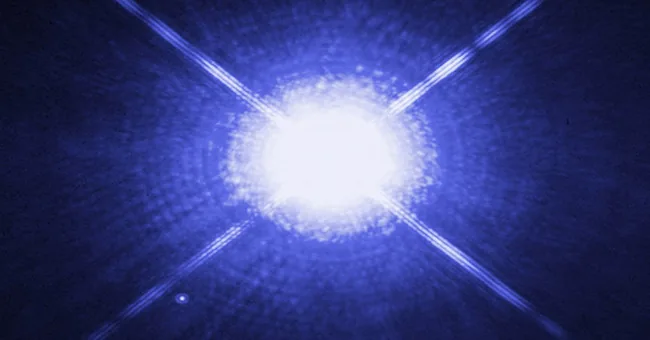
A star can stop fusing fuel in its core and still shine for an immense stretch of time. Its remaining heat escapes slowly from a dense remnant. White dwarf stars are not small versions of the Sun's present life; they are a different stage, where what supports the star and what makes it glow have changed.
A small core can remain after outer layers leave
A star like the Sun can shed its outer layers and leave a hot stellar core. Some expelled gas glows as a planetary nebula, though planets did not make the shell. Different stars can have other endings, so this path is common but not a rule for all stars.
The starting mass matters, and so can a companion. A very massive star can leave a different kind of remnant. The quiet white-dwarf route is one branch of the story, not the fate of every point that shines in the night sky above our heads.
Pressure can support a star without ordinary fusion
Electron pressure from quantum behavior helps support a white dwarf against gravity. It differs from the heat-based support of a star burning hydrogen like the Sun today. The remnant can stay dense and stable within physical limits without running the same kind of core fusion that powered its earlier life.
At high density, electrons cannot all fit into the same states. That rule helps create pressure. The idea is hard to see in a normal rock or glass of water, but it has a large effect here.
Related Stories
A glowing remnant can spend a long time cooling
A cooling remnant gives off stored heat rather than relying on sustained core fusion. It slowly grows cooler and fainter, with details set by mass, makeup, and other conditions. The process is long, so the star can remain in view long after its main phase of fuel burning ended.
Calling it dead can hide that slow life of heat. It does not become dark the instant fusion stops. The light we receive is part of that ongoing loss, not proof that the old core engine still runs.
A companion can change the quiet ending
Binary stars can exchange matter or merge, changing the quiet cooling story. Some systems produce nova outbursts, and white dwarfs feature in leading explanations of Type Ia supernovae. These are outcomes with specific conditions, not a claim that every cooling white dwarf will eventually explode as a matter of routine.
A close partner may send matter toward the remnant. A far one may have much less effect. The label white dwarf is not enough to tell us everything about a pair's past or future.
Cooling records can help tell the age of stellar groups
Models of white-dwarf cooling can help estimate the ages of star groups when matched to observations. The method needs information about the star and its earlier life. It is a useful record of time, not one clock with the same simple rate for every remnant that a telescope might find.
A faint point can tell a story through what it has lost. Its heat has been escaping over a long span, leaving clues in the light. Put those clues beside other stars and models, and the fading glow can help test the history of a much larger group.
Frequently Asked Questions
These questions separate a white dwarf's origin, support, and source of light. It can be hot and luminous while no longer operating like an ordinary hydrogen-burning star; its future also depends on companions. So the simple cooling picture is a starting point rather than a complete history for every system.
Will the Sun become a white dwarf?
Current models predict that the Sun will eventually leave such a remnant after losing its outer layers. This is a distant stage of its evolution, not a change expected on human timescales.
Why does it still shine if core fusion has ended?
It retains heat from its earlier history and radiates that energy away. Cooling takes a very long time. So the lack of sustained core fusion does not make it instantly dark.
Does every white dwarf become a supernova?
No, many cool without such an event. Explosive outcomes depend on particular conditions and interactions, often involving a companion, rather than following automatically from the white-dwarf label.