The planet nearest the Sun can keep water ice in darkness. That sounds like a contradiction until you ask where sunlight actually reaches. Ice on Mercury survives not on its blazing open plains, but in polar settings where deep shadows create cold traps, giving a small rocky world two very different thermal lives.
A hot planet can still contain cold places
Mercury receives intense sunlight, yet some polar crater floors remain in permanent shadow. Its tiny axial tilt helps preserve those dark areas. Suitable locations can stay cold enough for ice even while nearby lit ground becomes hot, showing why a planet's local conditions matter more than a simple label.
The important contrast is local, not a claim that Mercury has become an icy world overall. A crater floor and a nearby lit rim can experience very different conditions.
Mercury also lacks a substantial atmosphere that would redistribute heat in the way a dense atmosphere can. This helps make shadow and direct illumination especially important to the surface environment.
Radar provided an early clue
Radar reflections from parts of Mercury's polar regions showed unusually bright deposits consistent with possible ice. That evidence was intriguing because it overlapped with locations expected to remain cold. A bright radar return alone did not answer every question about composition.
This is how an unlikely-sounding idea becomes testable. The question changes from “How could ice exist near the Sun?” to “Do these particular shaded deposits have the properties expected of ice?”
Related Stories
A spacecraft connected several lines of evidence
MESSENGER gathered several kinds of evidence supporting polar ice. Scientists combined hydrogen-related measurements, reflectance, terrain, and thermal models. Some ice may be exposed in cold shadow, while other deposits are covered; the case is stronger than one supposed photo of a sunlit polar snowfield would suggest.
Some deposits may lie beneath a darker surface layer, while sufficiently cold places can allow exposed ice. The arrangement depends on local thermal conditions.
Delivery and preservation are separate questions
Finding a cold trap explains where ice can survive, not exactly how all of it arrived. Water-bearing impacts are among possible sources studied. Delivery, loss, and preservation are linked but distinct questions, so evidence for ice alone cannot date or identify every deposit's full history.
This separates supply from storage. A convincing account needs both, just as finding a sheltered freezer does not tell you who delivered every item inside it or when each arrived.
The discovery changes how we picture nearby worlds
Mercury shows why an orbital label cannot describe every surface environment. Shadow, slope, depth, and atmosphere affect local conditions. Polar ice therefore adds more than a surprising fact: it reveals places where water and other materials can persist on a world usually pictured only as hot.
The same habit helps elsewhere in planetary science: ask about slope, shadow, depth, atmosphere, and time of day before assuming an entire world behaves like one place.
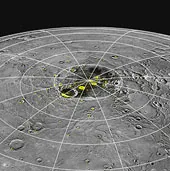
Mercury's dark polar areas are not lit like the bright face shown in many whole-planet images. Maps often need several data sets to reveal what lies in shadow. That is why a color overlay can be more informative than a plain photo.
The map can connect terrain with radar or thermal clues, provided its legend explains the colors and keeps measured data separate from inferred conditions.
Polar craters preserve volatile deposits, while the MESSENGER mission supplied measurements that helped test what those shaded areas contain.
Frequently Asked Questions
These questions separate the evidence for ice from its still-studied history. Radar, spacecraft measurements, and thermal models supply different clues. Their agreement supports the case, but it does not turn every map into a direct photograph or identify the exact origin and age of every frozen deposit.
How can ice survive on the closest planet to the Sun?
Some polar crater areas remain in long-term shadow and can be extremely cold. The relevant conditions are local, rather than the temperature of Mercury's sunlit plains.
Did MESSENGER photograph a sunlit polar snowfield?
The evidence comes from several measurements and models, not that simple scene. Some ice can be exposed in cold shadow, while other deposits may be covered.
Does the discovery prove exactly where Mercury's water came from?
No. Delivery and preservation are separate research questions. Evidence for ice does not alone identify the source and timing of every deposit.