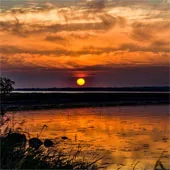
The Sun has not turned into a red star when it settles near the horizon. The light reaching you has changed along the way. Why sunsets turn red is a story about distance through air, with clouds and tiny particles deciding whether the evening ends in a pale wash or a band of burning color.
White sunlight contains a range of colors
Sunlight contains a range of colors. Air molecules scatter shorter wavelengths more strongly, changing the light that reaches an observer. Rayleigh scattering helps explain both the blue daytime sky and why a long route through air can leave the direct light richer in reds.
That difference matters because the sky and the direct beam can look different at the same moment. Light reaching your eyes from one direction has not followed exactly the same route as light arriving from another.
The horizon makes sunlight take a longer route
At sunset, light takes a longer route through the atmosphere. More short-wavelength light scatters away from the direct beam, leaving a larger share of red and orange. The Sun has not changed its basic stellar temperature; the route to your eyes has changed.
At noon, the path is often shorter. Near the horizon, the light passes through more air at a shallow angle.
The effect also depends on conditions along that path. A sunset is therefore not determined only by the air immediately around your house, but by a much larger stretch of atmosphere.
Related Stories


Particles can strengthen color or hide it
Aerosol particles can change a sunset, but more particles do not always improve it. Their size, type, amount, and position all matter. Thick smoke or haze may hide the Sun and harm air quality, while a lighter layer can alter the color display.
It is too simple to treat a vivid sunset as proof of pollution, or a dull one as proof of clean air. Many different atmospheric conditions can create similar impressions.
Clouds provide a screen at the right height
High clouds can still catch sunlight after the ground enters shadow. Their height, depth, and position shape the glow. Gaps near the horizon may let light reach them, while a thick cloud bank can block the same route and leave the scene much duller.
Yet too much cloud in the wrong place can block the display. The dramatic sky depends on a particular arrangement, not simply the total amount of cloud above the observer.
A familiar evening is a changing optical experiment
A sunset combines the Sun's position with air molecules, particles, moisture, and clouds along the light's route. Watching it change over several minutes reveals these factors more than judging one edited photograph. The pattern can be explained without losing the quiet surprise of seeing daylight become something that looks different.
Do not look directly at the Sun to test the explanation. The wider sky provides plenty to observe, and the changing light tells its story without requiring you to stare into the source.
Sunrise uses much of the same geometry. The Sun is low, so its light again takes a long route through air. The scene need not match the previous sunset, because clouds, haze, and air flow have changed in between.
A shared mechanism can produce many distinct views.
A longer light path and cloud illumination work together to shape the scene.
Frequently Asked Questions
These questions separate a change in sunlight from a change in the Sun itself. They also explain why a beautiful sky cannot diagnose air quality. Color depends on the whole light path, so local measurements are still needed to identify particles and assess their effects.
Does the Sun itself become red each evening?
No. The atmosphere changes the balance of light reaching you. The Sun is not rapidly changing its basic stellar temperature as it approaches your horizon.
Does a red sunset always mean pollution?
No. Molecular scattering and cloud arrangement can create vivid colors naturally. Particles can influence the scene, but color alone does not establish their source or concentration.
Why can clouds glow after the ground gets dark?
Higher clouds may still receive sunlight while lower areas are in Earth's shadow. Their height and position allow them to catch light that no longer reaches the ground directly.