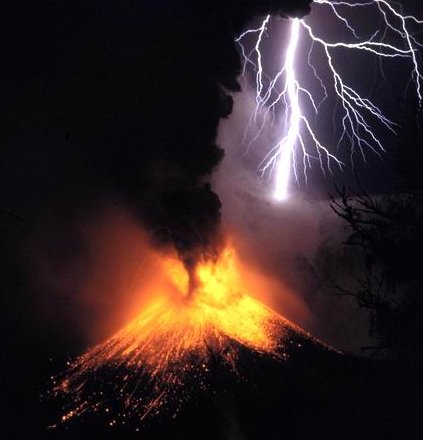
A mountain throws a dark column into the sky, then the cloud flashes from within. The scene looks like two disasters sharing one stage. Yet the eruption itself can help create the electricity.
What causes volcanic lightning begins with small particles colliding inside a vast, restless cloud.
A Cloud Made From Broken Rock
An eruption hurls ash particles into the air. Bumps between them can split electric charge, which builds up in parts of the cloud. When the gap grows large enough, a flash can release some of that stored energy.
The bright path is lightning inside or near the dark eruption plume.
Volcanic ash is not the soft gray dust left in a campfire. It holds fine bits of rock and glass. Those grains rush past one another in rough air.
Each small bump may seem slight, but a huge cloud gives such events room to add up across the plume.
Why Ice Can Join the Process
High ash clouds can reach cold air where water freezes. Bumps between ice crystals and other frozen bits help build charge, much as they do in a storm. Both ash and ice can play a role.
Their share of the work changes with height and the type of eruption.
A tall cloud has more than one kind of place within it. Fresh ash fills the zone near the vent. High above, cold air lets water freeze.
A photo flattens those zones into one dark shape, so it can hide the fact that different parts build charge in different ways.
Related Stories
What a Flash Can Reveal
Lightning tools can help teams spot some eruptions in the dark or behind clouds. These records add a useful stream of clues for volcano monitoring. They are not a full measure of risk.
Some eruptions make few flashes, and many things affect whether a tool can detect the discharge.
One flash is only one clue. A team can compare it with a shake in the ground or a view from space. If several tools agree, the account grows stronger.
A bright photo alone cannot tell how much ash is in the air or where the plume will go next.
Why Beauty Does Not Mean Safety
Volcanic lightning comes from charge built among grains and released in a flash. It needs no strange force beyond physics. But it belongs to an eruption that can bring ash, gas, and hot flows.
A beautiful distant photo cannot show all the risks that people face on the ground.
The scene starts with grains too small to notice from far away. Their shared effect can light a whole cloud. Knowing that does not make the sight dull.
It gives the flash a scale, from tiny bits of broken rock to a sky that seems to split for a brief moment.
Frequently Asked Questions
The flashes raise three plain questions. Are they the same as a storm’s lightning, do all eruptions make them, and can they warn us in advance? The answers depend on what builds the charge and what the tools can see, not just how bright one photo looks to us.
Is volcanic lightning the same as ordinary lightning?
Both include electrical discharge. The charging processes can differ, with ash collisions key near eruptions and frozen particles contributing higher in some plumes.
Does every eruption produce visible lightning?
No, eruptions differ in ash, water, height, and electrical activity. Even when lightning occurs, an observer or detector may not record it.
Can lightning alone predict the next eruption?
No, flashes mainly give facts about activity already occurring. Scientists interpret them alongside other monitoring data rather than using them as a standalone forecast.