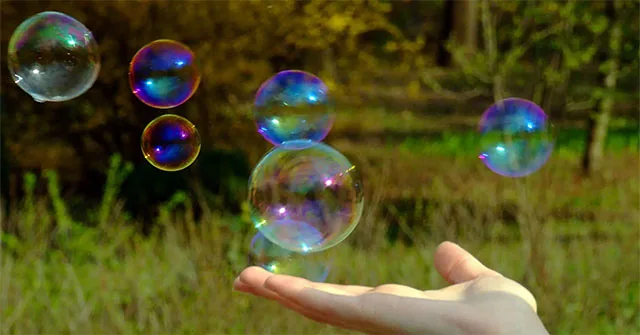
A soap bubble carries shifting bands of pink, green, and blue, although the liquid in the bottle looks nearly clear. Why soap bubbles have colors is not answered by hidden dye alone. The moving rainbow comes largely from light meeting a film so thin that two reflected waves can change what reaches your eyes.
A bubble holds water between surfactant layers
A bubble holds a thin liquid film between surfactant layers. The film can drain, stretch, and change while the bubble remains intact. Its colors belong mainly to light interacting with that shifting wall, rather than to fixed painted bands around a solid shell of trapped air.
Surface tension tends to favor a small area for a given enclosed volume, helping explain why an isolated bubble is often close to spherical.
Two reflections can meet with different timing
Thin-film interference occurs when reflections from different film boundaries meet. Their timing can make some wavelengths stronger and others weaker. The path through the liquid and the reflection conditions matter, so a nearly clear film can display colors without containing separate stripes of colored chemicals.
This is a wave explanation. The bright color marks where some wavelengths are favored in the reflected light, rather than identifying a stripe of blue or red material inside the water.
Related Stories

Thickness changes move the colors around
Film thickness varies across a bubble as liquid drains and flows. Because interference depends on the path through the film, those changes alter the colors visible at different places. Bands can slide, swirl, or fade while the bubble remains in roughly the same position.
The viewing angle also changes the path. Two people looking from different directions may therefore notice different colors in the same region.
Very dark patches can appear before a film breaks
A very thin patch can reflect little visible light and look dark. That does not always mean the film has vanished. Thickness, angle, and lighting shape the effect, and darkness can arise from the same wave behavior that produces bright colors elsewhere on the bubble.
The visible spectrum is only part of the full electromagnetic range. A pattern that suppresses much visible reflection may still interact with other wavelengths differently.
For a casual observer, the useful lesson is simpler: less reflected light can produce a dark region without requiring black pigment. Color and darkness can both arise from the same interference process.
A bubble is an easy place to watch wave physics
The best observation compares a bubble against a dark background under broad white light. Watch how the bands change as the film drains, rather than trying to assign one permanent color to the object. A clear explanation connects those changes with thickness and reflected waves.
The little bubble makes the invisible scale accessible. Its wall changes by tiny amounts, and ordinary daylight turns those changes into a moving display large enough for your eyes to follow.
Lighting can change the view even when the film stays much the same. White light contains many visible wavelengths, while a narrow-band source offers fewer. A dark background can make reflected colors stand out.
A bright background adds other light that competes with them. These are reasons to record the setup when comparing photos, rather than assume each change of color proves that the soap mixture has changed. The scene is a meeting of film, source, and eye.
Frequently Asked Questions
The common questions ask whether the colors come from dye, why they move, and why some patches become dark. These answers describe interference in a thin film under ordinary illumination. A particular soap mixture or photograph can add other effects.
Are the rainbow bands separate colored chemicals?
Usually the changing bands mainly reflect interference, not stripes of different pigments. Different wavelengths are reinforced or reduced as reflections from the thin film combine.
Why do the colors shift while the bubble stays still?
The liquid film can keep draining and flowing. Changes in thickness alter the interference pattern, even when the bubble's overall position barely changes.
Does a dark spot mean there is no film left?
Not necessarily. A very thin region can reflect little visible light and look dark. The effect depends on thickness, angle, and the surrounding illumination.