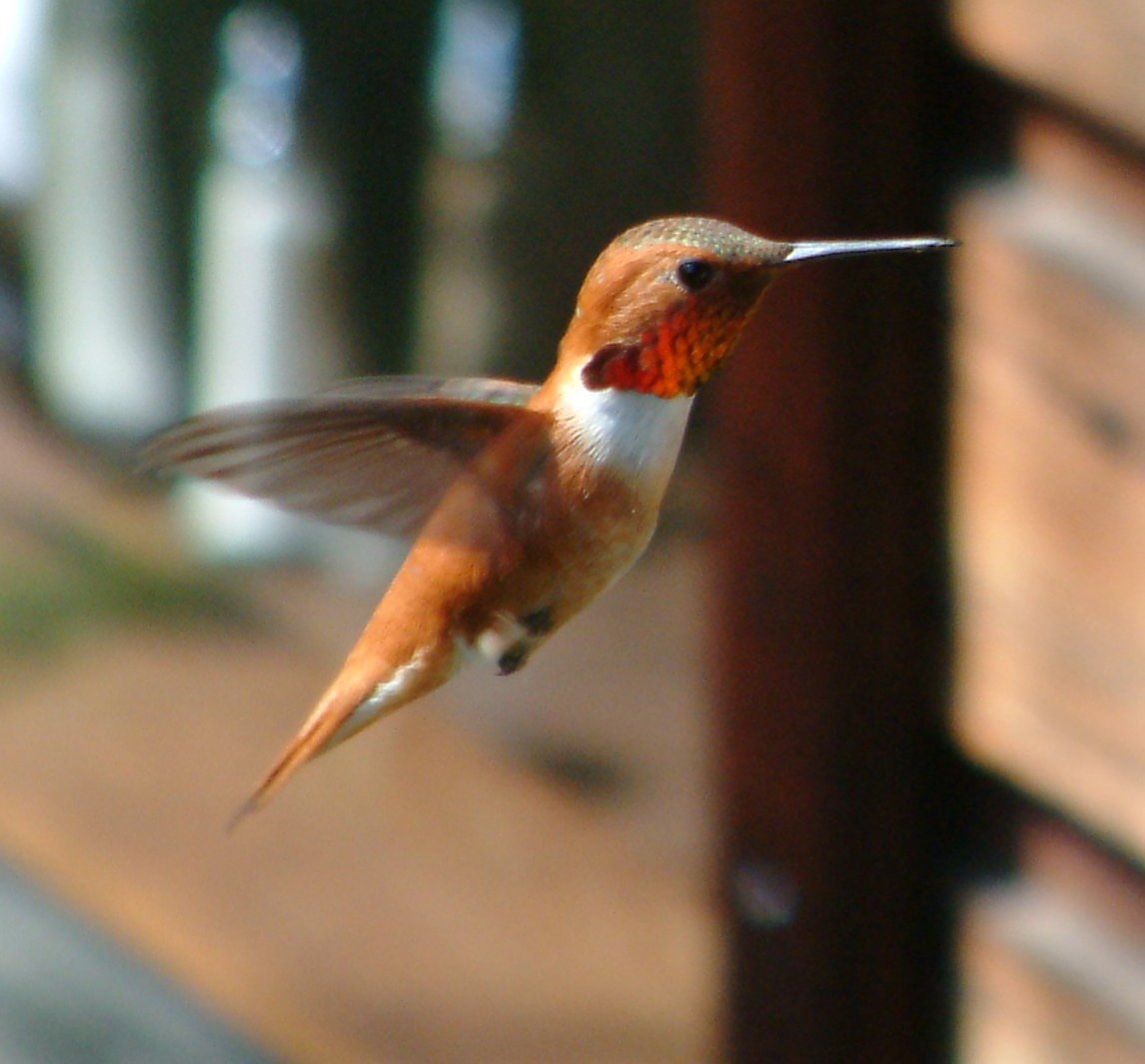
A hummingbird pauses beside a flower while its wings disappear into a blur. The body seems suspended from an invisible thread. It is doing something far more active than hanging still.
How hummingbirds hover is a story about moving air, twisting wings, and a high price paid for a useful meal.
Stillness Needs Constant Work
Hovering needs the bird to make enough upward force to balance its weight while staying near one position. The wings keep moving even when the body seems still. Hummingbird flight uses a sweeping motion and wing rotation that allow useful force during both halves of a wingbeat cycle.
A still bird does not mean still air. The wings push and twist while the body holds its place. Your eyes use the flower as a fixed point.
That makes the body easy to track, while the rapid work on either side of it dissolves into a soft blur.
Both Strokes Help, But Not Equally
Research on hovering rufous hummingbirds found more downstroke lift than upstroke lift, with roughly three quarters of weight support coming during the downstroke in that study. The upstroke still supplied a large share. This differs from the simple idea that both halves must contribute equal amounts whenever a bird hovers.
Those numbers belong to the birds and flight tested in the study. They are not a fixed split for every species or turn. The key point is simpler.
The wing’s return stroke does more than get it ready for the next push; it can help hold the bird up too.
Related Stories
Making Invisible Air Visible
Scientists studied the air around the wings using tiny tracer droplets, laser light, and imaging. Following those particles let them measure airflow rather than guess from wing positions alone. The method showed patterns of moving air and helped explain how the observed wing motion made the forces needed for hovering.
A camera aimed just at the bird sees only part of the task. The air is the other half. Tiny drops act a bit like leaves that reveal a breeze.
By tracking them, a team can compare the flow with the wingbeat and test how that beat makes lift.
The Reward Waiting in a Flower
Hovering costs energy, but nectar feeding offers access to a rich food source while the bird stays in front of a blossom. Flight control lets it adjust position, approach, and withdraw. That benefit helps explain why an expensive movement can still be useful in a small bird’s life.
There is no need to call the bird an insect in feathers. It has the bones and body of a bird. Some of the ways it moves air are shared with insects.
The result comes from working within that body’s limits, not from casting the limits aside when it reaches a flower.
Frequently Asked Questions
The main questions concern which stroke gives lift, whether the bird is truly still, and how scientists know what happens. The answers link visible wing motion with invisible airflow. They also show why a neat comparison with insects is helpful only when the differences in body structure remain in view.
Do hummingbirds get lift on the upstroke?
Yes, the upstroke can give useful lift during hovering. In research on rufous hummingbirds, the downstroke supplied a larger share of weight support.
Are hummingbird wings moving even when the bird looks still?
Yes, the wings are working rapidly while the body holds position. Hovering is active flight, not a pause in the need to make force.
Did scientists learn this just by filming the wings?
Wing images were key. But scientists also measured airflow. Tracer particles and laser imaging helped reveal what the nearby air was doing.