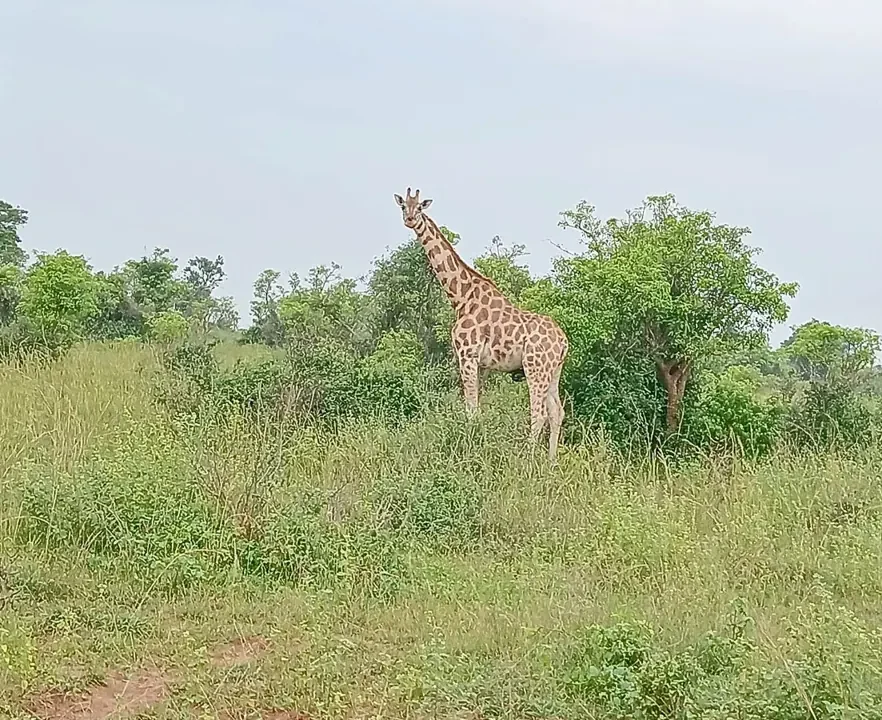
A giraffe can lower its head from far above you to reach a drink. Yet its neck does not contain a long chain of extra bones.
Count the main neck vertebrae and the result is seven. Your own neck has the same basic count, in a much shorter space.
Giraffe neck bones explained begins with that mismatch between number and scale. Evolution stretched a well-known mammal plan, then had to make the rest of the body work around it.
Seven bones can make very distinct necks
Giraffes have seven neck vertebrae, like humans and most other mammals. Their striking reach comes mainly from elongated neck bones rather than a greatly increased count. The joints, muscles, and supporting tissues help that long structure move while carrying a head well above the animal’s shoulders.
Bone count is therefore a poor guide to overall length. Seven small pieces and seven long pieces can build very distinct structures.
The link becomes easier if you picture a short row of blocks beside a row of much taller ones. The number stays the same.
But the scale shifts. In a living neck, that shift also affects weight, leverage, and the work of moving.
A long neck serves more than lunch
Giraffe anatomy allows access to leaves beyond the reach of many other browsing animals. The neck also plays a role in social encounters, including necking behavior in which males swing their necks and heads during contests. These uses make a simple feeding-only story less complete than it first sounds.
That is the challenge with an elegant classroom answer. Reaching high leaves matters, but so can rivalry, body size, habitat, and success at having young.
Related Stories
A shorter-necked relative offers a clue
The okapi comparison helps teams study traits that set giraffes apart from a close living relative. They compare genomes to find clues linked to growth and body function. A difference in a gene can suggest a path to study, but it cannot explain a long neck alone.
Penn State research teams highlighted shifts in genes involved in growth, alongside traits linked to the giraffe’s odd blood-flow demands. The findings connect shape with the systems supporting it.
This is detective work across scales. A long neck, a sequence of bones, and a stretch of DNA each reveal something distinct.
A useful answer has to connect them, rather than letting one promising gene replace the whole animal.
Extra reach comes with extra demands
Evolutionary trade-offs appear when a tall body must move, drink, and supply blood to a distant head. A long neck brings opportunities, but it also shifts leverage and blood flow. The giraffe’s body works as a linked system, not as a plain mammal with one stretched part attached on top.
Watch a giraffe drink and the scale becomes clear. Bringing the mouth to water needs an odd stance, and raising it again shifts the head’s position sharply.
It is tempting to label every detail a perfect solution. A better approach is to ask what the animal gains, what it must manage, and which clues support each answer.
Seven bones are the opening surprise. But the real story is how a whole body lives with them.
Frequently Asked Questions
Giraffes show how much a body can change while keeping a basic bone count. Their seven neck vertebrae are larger and shaped for a body unlike ours. To grasp the difference, we need to study growth, movement, feeding, and blood flow together, not just count bones.
Do giraffes and humans have the same number of neck bones?
Both normally have seven neck vertebrae. They share the basic count.
The bones still differ in shape, size, strength, and the way their joints move.
Did giraffes simply add more vertebrae as their necks evolved?
Their striking neck length mainly involves shifts in the size and proportions of existing vertebrae. The well-known seven-part mammalian pattern stays, even though the final structure looks very distinct.
Does the long neck prove food competition was the only cause?
No, present-day usefulness does not show one exclusive evolutionary cause. Feeding, social rivalry, growth, and the demands of a large body all deserve consideration when evaluating the clues.