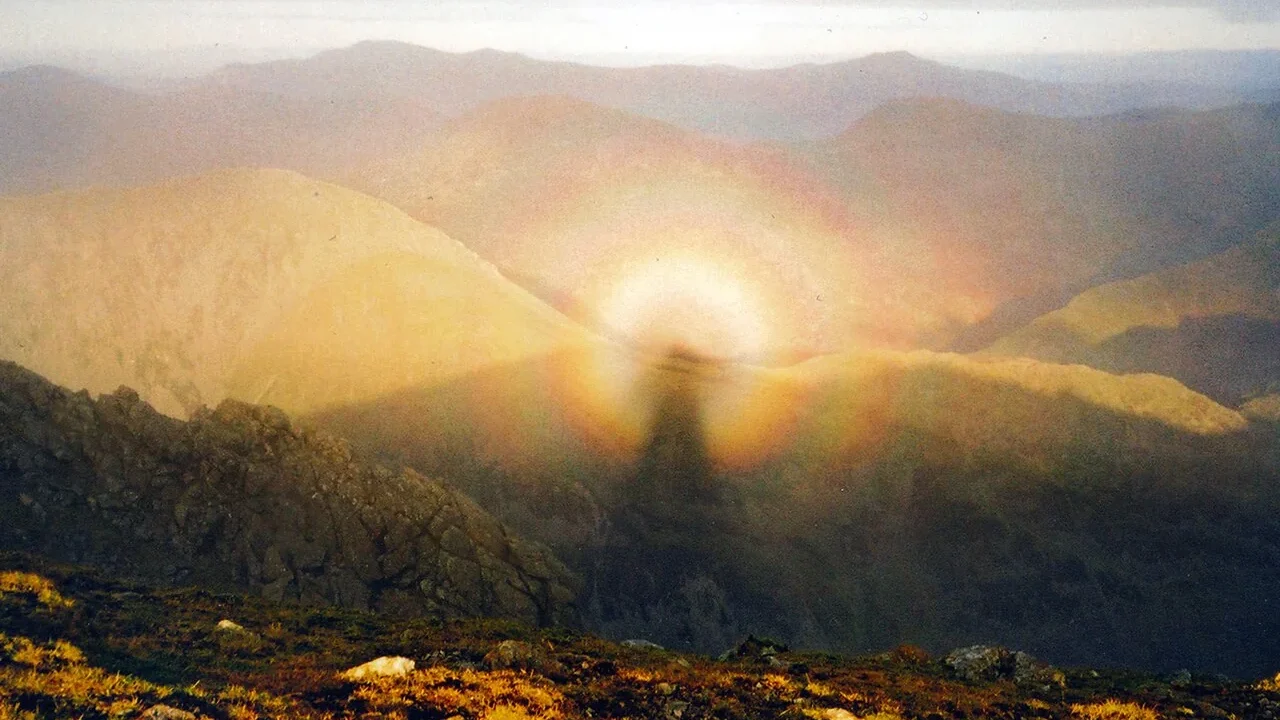
The figure stands in the cloud ahead of you. It has no face, seems far too large, and wears a pale ring of color around its head.
Then you lift an arm. The stranger lifts one too.
The ghost has been borrowing your outline all along.
Brocken spectre explained begins with that simple test. The sight feels uncanny because the light behaves normally while the fog removes the clues your eyes use to judge distance.
Sunlight turns mist into a screen
A Brocken spectre forms when sunlight behind an observer casts a mountain shadow onto mist or cloud ahead. The outline can look huge because the cloud lacks well-known objects to judge scale. Its size and shifting form reflect the arrangement of sunlight, the observer, and suspended water droplets.
The cloud projection is not a person standing across a valley. It is light being blocked by the person who sees it.
As fog moves, distinct parts of that shadow become clear. Arms may stretch or seem detached.
A solid silhouette on a wall has clean edges; a shadow spread through a moving cloud can behave like something alive.
Why the figure seems so huge
The optical illusion grows stronger when the shadow falls into a scene with no clear scale. You may judge the cloud as distant and then read the figure as a giant. Shadows can also extend through mist at distinct depths, changing the shape you think you see.
Your eyes are good at measuring a person beside a door. They have fewer anchors when the entire view is gray air.
The eerie feeling comes from that mismatch. A well-known human outline appears where no person could stand, and the mind supplies a size before it has enough sound clues.
The first impression can arrive much faster than the answer.
Related Stories


The colored rings are a second effect
A colored glory may surround the shadow near its head, but it is a light pattern rather than part of the dark silhouette. Sunlight interacts with small fog droplets and returns toward the observer. The rings center on the antisolar point, directly opposite the Sun from that observer’s position.
That geometry makes the sight personal. A companion standing nearby has a slightly distinct viewing line and may see a glory centered on a distinct shadow.
The shadow and rings often appear together. Yet they are not the same phenomenon.
One comes from blocking light. The other comes from how light interacts with droplets and reaches your eyes again.
A single haunting scene contains two linked stories.
A ghost you can watch shift
Brocken spectres often appear in mountain mist, but the key parts are geometry, sunlight, and a cloud screen. The display shifts as the Sun, cloud, or observer moves. Seeing a shadow follow an arm movement gives a useful clue, though the colored rings may stay subtle or briefly disappear.
The name comes from the Brocken, a mountain in Germany. It adds a memorable place to a phenomenon that can occur elsewhere under suitable conditions.
If you notice one while walking, pause on secure ground. The spectacle is in the air, and moving toward it cannot bring a distant figure closer.
Let the drifting fog do the moving while you watch the light reveal its trick.
Frequently Asked Questions
This apparent figure is a real shadow seen under odd viewing conditions, not proof of a second being in the cloud. The shape, apparent size, and colored rings have related but distinct causes. Keeping those parts distinct makes the event easier to grasp without taking away its strange beauty.
Is a Brocken spectre a type of rainbow?
The shadow itself is not a rainbow. It may appear with a glory, whose colored rings form through interactions between light and tiny droplets and differ from a well-known rain rainbow.
Why does the spectre copy my movements?
Your body is blocking the sunlight that creates the shadow. Moving an arm shifts the blocked light.
So the projected outline shifts with you.
Can two people see the same glory?
Nearby people can observe the same conditions. But each has their own viewing direction.
Each person’s glory is centered opposite the Sun from their own position, rather than being one fixed ring in space.