

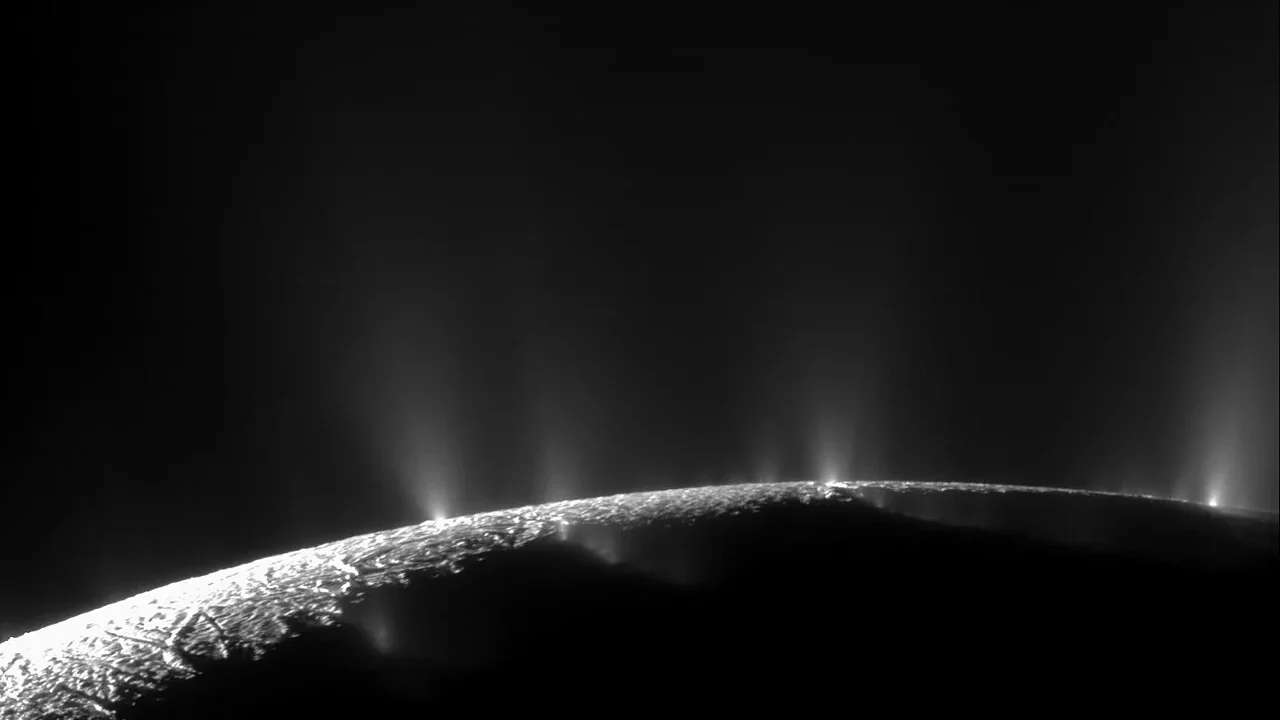
An ocean hidden beneath ice has found a way to throw samples into space. Near a small moon’s south pole, jets release water vapor and icy grains through cracks in the ice.
A passing spacecraft could study the spray without drilling through the frozen shell.
Enceladus ocean plumes turned a small moon of Saturn into a place of huge interest. Their greatest promise is not a picture of alien life.
It is a chance to ask clear questions about a hidden sea.
Cracks connect the surface to a hidden world
The moon sends water vapor and ice grains from near its south pole through long cracks called tiger stripe fractures. The spray gives clues to a salty sea below the crust. Teams use its chemistry with other readings, since one photo cannot show the whole story.
Against dark space, the spray looks delicate. Its value is hard to overstate: it gives tools a way to study a sea we cannot see.
A plume is not a clear window through the ice. The grains shift as they rise, freeze, and travel outward.
We need to know how that trip works. We also need to know what each tool can measure.
A spacecraft read the passing grains
The Cassini spacecraft studied Enceladus during its mission around Saturn. Its tools studied gas and solid grains near the moon and farther out. Salty ice grains helped research teams connect the spray with liquid water that had interacted with rock, rather than treating it as plain surface frost alone.
That difference matters when reading the findings. Teams must work back from a tool’s signal to a grain.
Then they must work out where that grain began. Each step must fit what happened during the flight.
Related Stories

Chemistry suggests an ocean with energy
Cassini found hydrogen gas linked to the moon, and this supports the chance of hydrothermal activity where water meets rock below the sea. On Earth, some microbes gain energy from chemical reactions rather than sunlight. That link makes the moon interesting, but it does not show that anything lives there.
A later phosphorus discovery added a second key clue. The team found signs of phosphates, a form of the element, in grains linked to the sea.
The element helps build key parts of Earth life. Finding it makes the case for a closer look at the sea stronger.
A promising home is not an inhabited one
A habitable ocean could support life as we know it, while an inhabited sea has life in it now. Water, useful chemistry, and fuel help address the first question. The second needs tests that can tell living things from matter that forms without them.
That boundary keeps the story exciting without inventing a discovery. No tool has returned a proven sign of life from the moon or a sample shown to contain one.
The plume gives future flights a rare way to reach that target. The next task is to ask sharper questions of a grain.
Where did it form? What happened on the way out?
Could its contents form without life? Those questions put a distant sea within reach of a close test.
Frequently Asked Questions
The moon draws interest because its plumes bring samples of a hidden sea into space, and the findings make the sea worth a search for life, while leaving life itself unproven. Water, salts, fuel, and elements are parts of that case. They do not replace a clear sign of life.
Did Cassini find life in the plumes?
The craft did not find proven signs of life. It found clues that the sea could suit life.
That is not the same as finding living things.
Why is phosphorus key in the ocean?
Phosphorus is part of key molecules in Earth life, including DNA and energy-carrying compounds. Detecting phosphates makes one needed ingredient less unclear.
But this does not prove that anything lives there.
Could research teams study the ocean without landing?
A flight through the spray can study grains linked to the sea. To read them well, teams must check what shifts as they leave the moon and meet the craft.

.jpg)